
Artificial Intelligence and the Future of Homeopathy: A Semantic Pattern-Matching Perspective
By Marco Ruggeri and Simone Ruggeri
Abstract
Homeopathy, since its inception, has been a discipline rooted in the meticulous observation and matching of complex phenomenological patterns. The successful prescription relies on aligning the multifaceted symptom-image of the patient with the pathogenetic portrait of a remedy, a process that is profoundly semantic and individualized. Traditional tools like repertories and materia medicas, while invaluable, represent a 19th-century solution to a 21st-century big data problem. The sheer volume and narrative complexity of homeopathic knowledge—spanning over two centuries of provings, clinical cases, and theoretical texts—present a significant challenge for manual synthesis and analysis. This paper posits that the recent advancements in Artificial Intelligence (AI), particularly in Natural Language Processing (NLP), large language models (LLMs), and semantic vector spaces, offer a technological paradigm that is uniquely aligned with homeopathy’s core epistemological framework. While these AI technologies are well-established in other domains, their systematic application to homeopathy represents a novel and transformative approach that has never before been fully realized. We explore how AI can revolutionize homeopathic practice, research, and evidence generation by transforming our static repositories of knowledge into a dynamic, interconnected, and continuously learning ecosystem. Through a concrete case study—a semantic vector space built from 200 major polychrest remedies representing millions of words of homeopathic literature—we demonstrate not merely the theoretical potential but the practical feasibility of these technologies. This paper serves as both an introduction for the homeopathic community to these powerful tools and a roadmap for their implementation, explaining their function, their profound implications for the discipline, and a vision for a future where technology enhances the art and science of homeopathic medicine.
1. Introduction: A Science of Semantic Patterns
At its heart, homeopathy is a science of information, a discipline dedicated to the perception and matching of complex phenomenological patterns. The practitioner’s essential task is to discern a coherent, peculiar “symptom-gestalt” from a patient’s narrative of suffering and align it with a corresponding remedy portrait from our vast library of provings and clinical experience. This is not a simple biochemical transaction; it is a profound act of semantic pattern matching. The living language of the patient must be meticulously translated and mapped onto the equally rich language of the Materia Medica. The success of this art depends entirely on the clinician’s ability to navigate an immense, textually complex dataset: a challenge Hahnemann himself confronted and sought to solve with the creation of the first repertories. From a systems biology perspective, this pattern-matching principle can be understood through the regulation of homeodynamic networks, where remedies may interact with sensitive regulation systems through complex information, enabling reorganization of cellular, tissue, and neuro-immuno-endocrine responses.[1]
Yet, for two hundred years, the fundamental architecture of our information tools has remained largely unchanged. The repertory, for all its utility, is a manually indexed, hierarchical database; the Materia Medica, a collection of brilliant but siloed narrative treatises. These 19th-century solutions, while indispensable, are straining under the weight of a 21st-century big data problem. Their rigid structures, the inherent biases of their construction, and the difficulty of systematically integrating new clinical wisdom mean that the deepest correlational patterns within our literature remain locked away in narrative form, their full potential untapped.
This paper argues that this informational crisis is not a threat, but an opportunity. The emergence of sophisticated Artificial Intelligence (AI) offers a path forward that resonates deeply with homeopathy’s foundational principles. Modern AI, especially the large language models (LLMs) that power applications like ChatGPT, are not merely calculators; they are pattern-recognition engines that operate on language and meaning. They can read, understand, and correlate vast amounts of unstructured text, perceive subtle relationships, and identify patterns that would be invisible to the unaided human mind.
AI is not an alien technology to be feared, but rather the logical and necessary evolution of the tools Hahnemann himself pioneered. It offers a method to manage the immense informational complexity of our discipline, to refine our understanding of remedies, and to build a new and robust evidence base founded on the principle of individualization. We will explore the key AI technologies relevant to homeopathy, demonstrate their power through a concrete case study, and map out a future in which technology does not supplant, but profoundly enhances, the art and science of homeopathic medicine.
2. Demystifying Artificial Intelligence for the Homeopathic Practitioner
To appreciate the potential of AI, it is essential to understand some core concepts, not through complex mathematics, but through their function and relevance to our work.
2.1 Natural Language Processing (NLP): Teaching Computers to Read
At its heart, NLP is a field of AI that gives computers the ability to understand human language. All of our foundational texts (provings, materia medicas, clinical casebooks) are written in natural language. NLP provides the foundation for transforming this unstructured text into structured, analyzable data. The modern NLP techniques that power today’s AI systems can process vast amounts of text, understand context and nuance, and extract meaningful patterns from narrative descriptions. This capability is what allows AI to work with the complex, symptom-rich language of homeopathy, moving beyond simple keyword matching to true semantic understanding. In homeopathy specifically, NLP can extract meaningful information from patient records, research papers, and clinical notes, enabling the creation of sophisticated prognostic factor research models that contribute to evidence-based decision-making in homeopathic practice.[2,3]
2.2 Word Embeddings: The Geometry of Meaning
Perhaps the most revolutionary concept for homeopathy is that of word embeddings. Traditionally, a computer understood “anxiety” and “fear” as being no more related than “apple” and “database.” They were just strings of characters. Embeddings teach the computer to understand words by their contextual meaning, much like a homeopath learns to understand a symptom by its context within the case.
An AI model reads millions of sentences from a vast corpus of text (in our case, the homeopathic literature) and learns the intricate relationships between words based on how they are used. It then represents each word or phrase as a point—a vector—in a high-dimensional “meaning space.” In this space, proximity equals similarity. The vector for “anxiety” will be naturally located close to the vectors for “apprehension” and “dread.” The vector for “burning pain” will be closer to “stinging pain” than to “dull ache.”
This is the technology that unlocks semantic search. When a patient says they feel “a deep sense of gloom,” a semantic search tool doesn’t just look for the word “gloom.” It searches in that region of the meaning space, instantly finding repertory rubrics for “Sadness,” “Depression,” or “Forsaken feeling,” even if the exact words don’t match.
To demonstrate this with actual data: when a patient describes “overwhelming fear that comes on when the sun goes down,” a semantic search of Murphy’s Repertory (136,924 embedded rubrics) returns as the top match: “Mind - Fears, evening, twilight” (similarity: 0.80)—despite sharing no exact words beyond “fear.” Similarly, “I want company but push people away” finds “Mind - Company, desire for, alone while aggravated, yet fear of people” (0.74), capturing the paradoxical pattern perfectly. When a patient reports “dreams where I’m floating through the air,” the system instantly locates “Sleep - Dreams, floatings” (0.78), a rubric the practitioner might not have thought to look up manually. This moves beyond keyword matching to meaning matching, which is the very essence of homeopathic case analysis. It allows the computer to grasp the underlying phenomenon, not just the surface-level words used to describe it.
2.3 Transformers and Large Language Models (LLMs): Understanding the Whole Picture
If embeddings allow a computer to understand words, Transformers and the Large Language Models (LLMs) built upon them allow it to understand the entire narrative. A transformer is an AI architecture that is exceptionally skilled at understanding context. When it reads a sentence, it pays attention to all the other words simultaneously, weighing their importance to grasp the precise meaning of each word within the whole. It understands that “a burning pain in the stomach after eating” is a completely different phenomenon from “a burning desire for justice.”
This is analogous to how a homeopath listens to a case. You don’t just collect a list of symptoms; you perceive the pattern that connects them—the underlying state that gives rise to the headache, the digestive issues, and the peculiar emotional state. LLMs do something similar with text. By analyzing the entire narrative structure, they can perform incredibly sophisticated tasks. An LLM can read a 10-page case transcript and generate a concise summary of the key symptoms and their relationships, suggest potential themes (e.g., “This case has a strong theme of betrayal and unexpressed grief”), or even translate obscure 19th-century homeopathic terminology into modern, understandable language. They are tools for synthesis, capable of seeing the forest for the trees.
2.4 Knowledge Graphs: A Complementary Future Direction
While the vector space model forms the core of the implemented system, it is worth noting another AI technology that could complement this approach: knowledge graphs. A traditional repertory is a tree-like hierarchy. You start with Mind, then go to Anxiety, then Company, and so on. This is useful but rigid. A knowledge graph is a more flexible network structure where each piece of information (a remedy, a symptom, a modality) is a node, and their relationships are edges.
For example, a knowledge graph could connect Phosphorus to “anxiety about health,” but also connect Phosphorus to Arsenicum album with an edge labeled “shares anxiety.” It could link Sulphur to Calcarea carbonica with an edge labeled “complementary remedy.” This creates a rich, interconnected web of knowledge that can be explored in any direction. While not implemented in the current project, knowledge graphs represent a promising avenue for future development, potentially integrating with the vector space model to create an even more powerful system for homeopathic knowledge management.
3. A Case Study: The Homeopathic Vector Space Project
The theoretical concepts discussed above—NLP, embeddings, and LLMs—can seem abstract. To make them concrete, we will walk through a case study of a software system built specifically to apply these technologies to the homeopathic corpus. The goal of this project was to transform our vast, unstructured textual legacy into a structured, navigable “semantic vector space,” where the relationships between remedies can be explored mathematically and visually.
The process was architected as a sequential data pipeline, moving from raw source texts to final, usable vector embeddings in three key stages.
3.1 Stage 1: Consolidation - Building the Foundation
The first challenge in any large-scale analysis is to gather and organize the source data. The homeopathic literature is vast and diffuse, comprising dozens of materia medicas and repertories. The initial step, therefore, was a process of consolidation. An automated script was developed to iterate through a master list of remedies, gathering and organizing the raw source material. For each remedy, it performed two actions:
Materia Medica Aggregation: It systematically gathered all available Materia Medica texts for that specific remedy from the digitized library.
Characteristic Rubric Filtering: It scanned repertory data to extract only the most characteristic and reliable rubrics for that remedy—symptoms graded as 3rd or 4th degree, which represent the most consistently verified pathogenetic effects.
The output of this stage was a single, comprehensive text file for each of the 200 remedies in the system. Each file represented the complete, raw data package for that substance, containing its full Materia Medica portrait alongside its most defining repertory symptoms. This step created a clean, consistent, and foundational dataset for the subsequent AI-driven stages. This data mining approach continues Hahnemann’s original empirical methodology, applying modern statistical concepts to extract patterns from large homeopathic datasets that are not visible to “the naked eye.”[4]
3.2 Stage 2: Synthesis - Distilling the Essence with LLMs
While the consolidated files were comprehensive, they were also noisy and voluminous. A raw text dump of everything ever written about Sulphur is not the same as the “essence” of Sulphur. The next stage aimed to perform a task analogous to what a master homeopath does through years of study: to read, comprehend, and synthesize this vast information into a coherent and distilled portrait.
This is where a powerful Large Language Model (google/gemini-2.5-pro) was employed through an automated synthesis pipeline. For each consolidated remedy file, the entire text was sent to the LLM with a specialized prompt. The prompt instructed the AI to act as a homeopathic expert and perform a deep analysis of the source material to produce three key summaries:
The Remedy Essence: A concise, narrative description of the core themes, archetypal patient, and central delusion of the remedy.
Keynote Symptoms: A bulleted list of the most characteristic and guiding symptoms, extracted and synthesized from the noise of the full text.
The Archetypal Patient: A brief, evocative story or “vignette” of a person who would most likely need this remedy, bringing the pathogenetic data to life.
The LLM was not simply extracting sentences; it was performing a sophisticated act of summarization and conceptual distillation. The output, termed a “Super-Document,” contained both the AI’s high-level synthesis and the original source data, creating a rich, layered document for each remedy.
Example: Pulsatilla Synthesis
To make this process concrete, here is an excerpt from the AI-generated synthesis for Pulsatilla pratensis:
REMEDY ESSENCE > Pulsatilla, the “wind-flower,” embodies the principle of changeability and yielding. Its sphere of action centers on the mucous membranes and the venous circulation, producing a state of gentle stasis and relaxation throughout the system. The underlying pattern is one of fluctuation and unpredictability, seen in wandering pains, shifting moods, and alternating symptoms, all driven by a deep emotional need for connection and sympathy. This leads to a profound aggravation from warmth, stuffy rooms, and rich food, with a corresponding, almost desperate, desire for cool, open air and gentle motion for relief.
KEYNOTE SYMPTOMS (Selected) - Mild, gentle, yielding, and easily weeping disposition; cries when narrating symptoms, yet is greatly ameliorated by consolation and sympathy. - Symptoms are constantly changing and shifting: pains wander rapidly from joint to joint, no two stools or chills are alike, and moods are highly variable. - Thirstlessness with nearly all complaints, even during fever or with a dry mouth. - Discharges from all mucous membranes are characteristically thick, bland, and yellowish-green. - Marked aggravation from warmth, in a warm or stuffy room, and from rich, fatty foods like pork or pastries. - Decisive amelioration from gentle, slow motion in the cool, open air; an intense desire for open windows.
This synthesis, produced entirely by the LLM from analyzing the full source texts, demonstrates the model’s ability to extract not just information, but meaning—the archetypal pattern that a human homeopath would recognize as the essence of Pulsatilla.
3.3 Stage 3: Embedding - Mapping the Geometry of Meaning
The Super-Documents, while now much more refined, were still text. The final and most crucial step was to convert this synthesized textual meaning into a mathematical format that a computer can analyze. This is the process of embedding.
Using a specialized embedding model (gemini-embedding-001), an automated processing pipeline extracted the “Essence” and “Keynote” sections from each Super-Document separately and generated three distinct embeddings for each remedy: an essence-only vector, a keynote-only vector, and a combined vector. Each of these vectors is a list of 3072 numbers, enabling high-resolution semantic analysis. While the combined embedding captures both constitutional and symptomatological dimensions, the decomposed analyses presented in this paper leverage all three types to reveal the multidimensional nature of remedy relationships.
This vector represents the remedy’s unique “address” in a vast, multi-dimensional semantic space. In this space, remedies that are phenotypically similar (like Bryonia and Belladonna in their acute inflammatory states) will have vectors that are mathematically “close” to each other. Remedies that are complementary (like Sulphur and Calcarea Carbonica) or share common constitutional features will also exhibit proximity and geometric relationships within this space.
This three-stage pipeline successfully transformed the raw, narrative library of homeopathy—amounting to millions of words across thousands of documents—into a structured dataset of high-dimensional semantic vectors. It is this vector space, representing 200 of the most important polychrest remedies, that enables the next layer of tools: interactive exploration and the discovery of hidden patterns.
4. Visualizing Semantic Relationships
A 3072-dimensional vector space is a powerful mathematical abstraction, but it is not intuitively understandable to the human mind. The true value of this project is unlocked by an interactive research interface—a web-based application that allows researchers to visualize and query these complex relationships. By translating vector mathematics back into graphical and textual forms, we can begin to “see” the hidden architecture of the Materia Medica.
The UI provides several key tools for exploring the remedy space, each offering a different lens through which to view the data.
4.1 Navigating the Global Remedy Map
The most fundamental visualization is a 2D map of the entire remedy space. Using dimensionality-reduction algorithms like t-SNE or UMAP, the system projects the 3072-dimensional vector data down to two dimensions, arranging all remedies on a single chart. As with the similarity matrices, we can decompose this visualization by embedding type to reveal how constitutional essence versus symptomatology structure the remedy landscape differently.
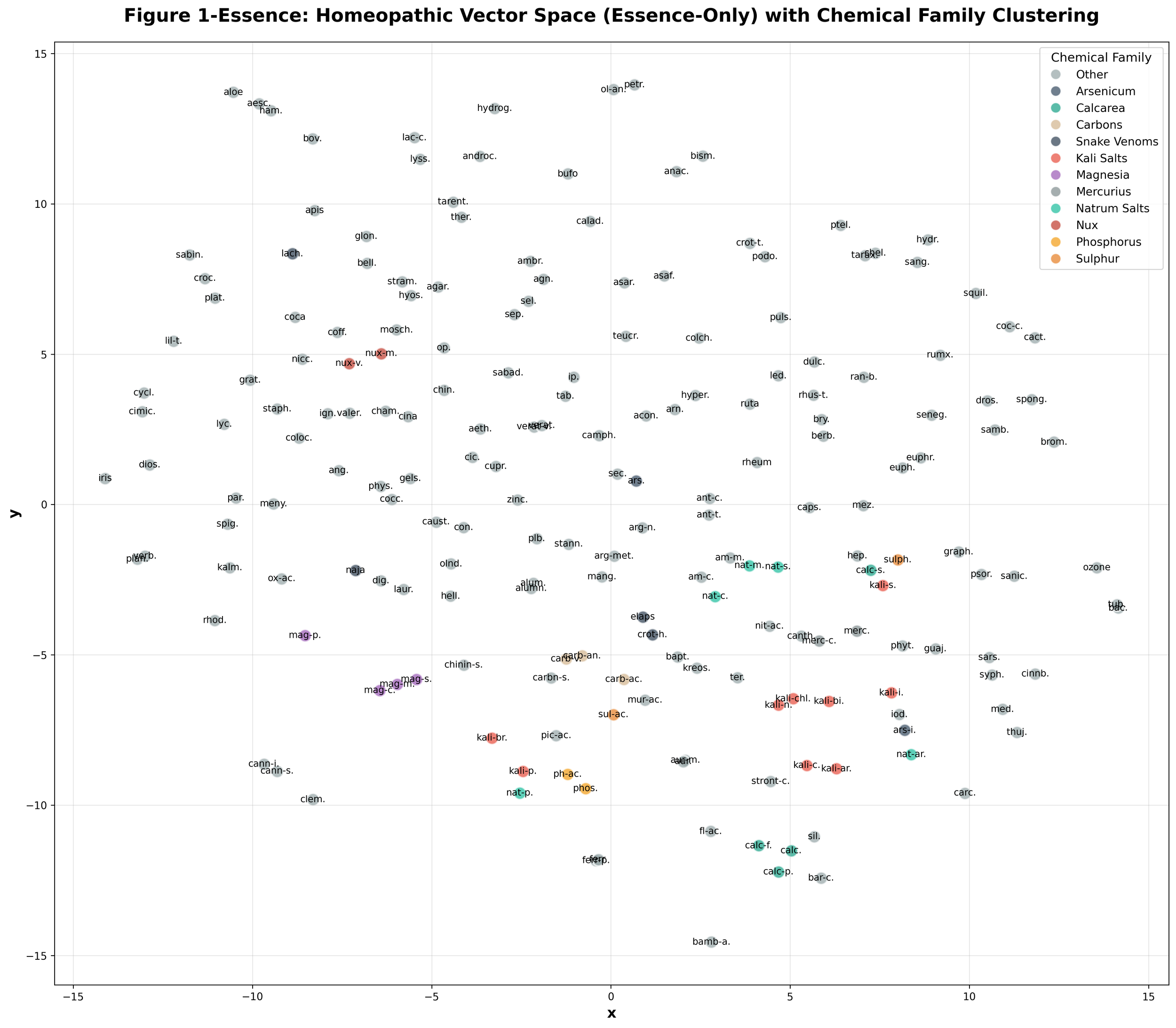
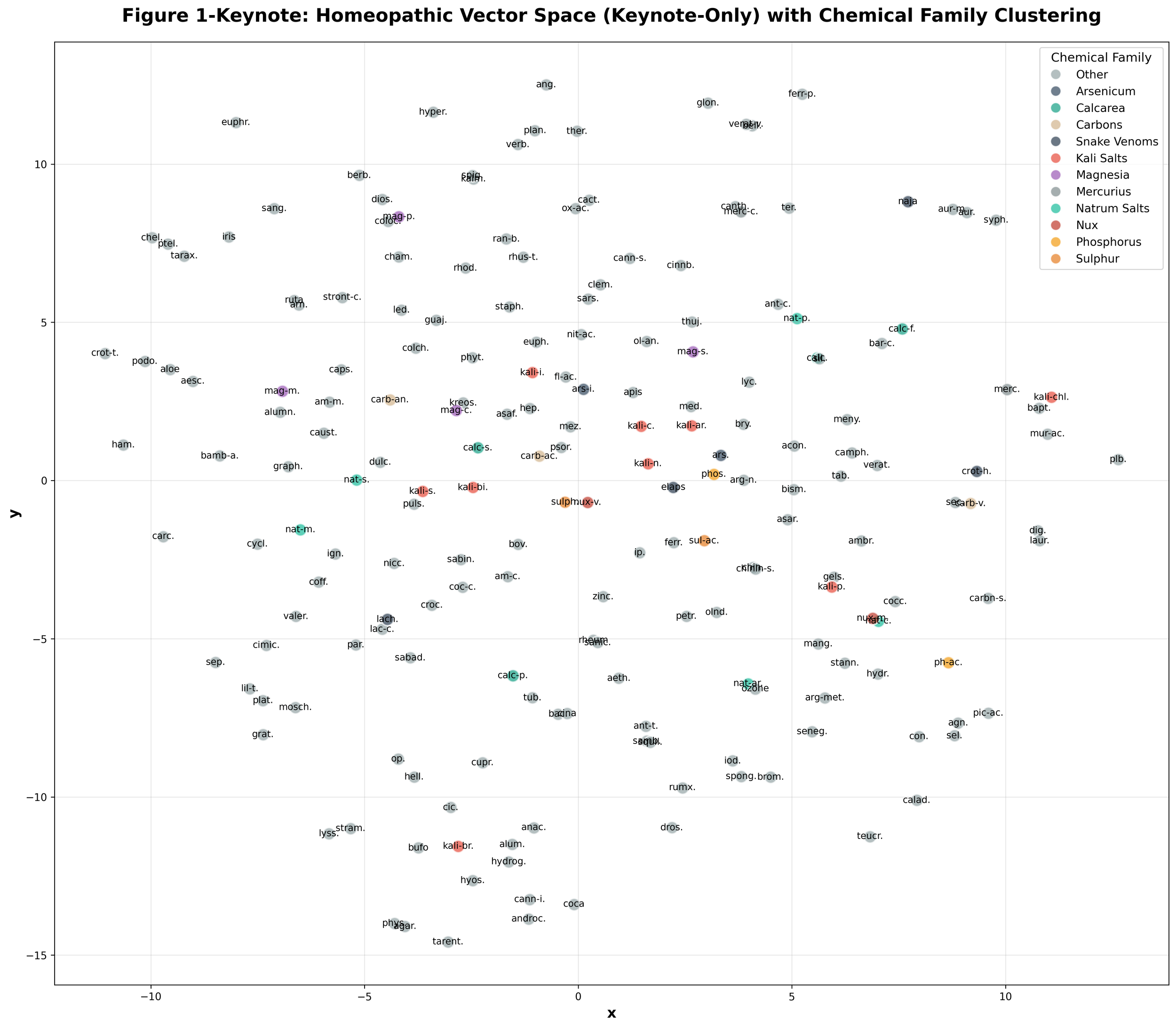
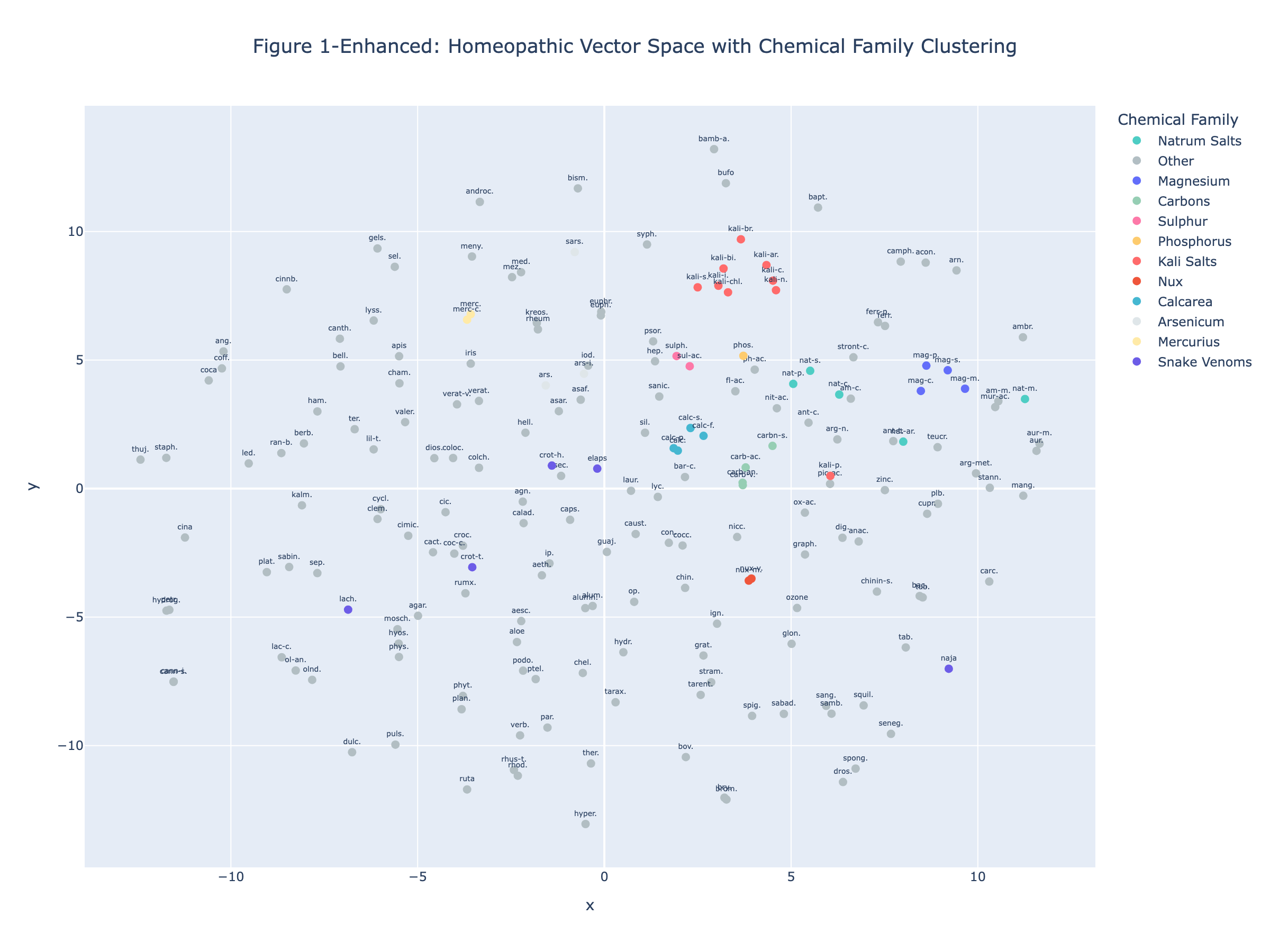
Figure 1: Global Structure of the Remedy Vector Space by Embedding Type. Three t-SNE projections of 200 remedies, color-coded by chemical family. (A) Essence-Only Embeddings reveal dramatically tight constitutional clustering: Kali salts (red) form a compact, coherent group (mean intra-family distance 1.68), as do Calcarea (teal, 1.14), Carbons (tan, 0.65), and Mercurius (gray, 0.16). The overall mean intra-family distance is 1.85. (B) Keynote-Only Embeddings show significantly more dispersed clustering (mean intra-family distance 5.53)—nearly 3× larger—with symptom profiles converging across chemical boundaries. The same Kali salts that cluster tightly in essence space are scattered across multiple regions in keynote space. (C) Combined Embeddings integrate both dimensions. This decomposition demonstrates a profound insight: chemical families share constitutional essence more than symptomatology. The AI has learned that remedies from the same chemical family are “similar in soul” (essence) but may manifest diverse symptom patterns (keynotes), validating the homeopathic principle that we treat the pattern, not the chemistry.
This map reveals the inherent structure of the remedy relationships at a glance. The dramatic difference between essence and keynote clustering validates that the vector space captures two distinct but complementary dimensions of remedy similarity. Chemical families cluster by constitutional nature, while symptoms converge phenomenologically across taxonomy—exactly as homeopathic theory predicts.
4.2 Finding a Remedy’s Closest Relatives: Nearest Neighbors
Beyond the global map, we can zoom in on a single remedy and ask a very simple but powerful question: “Who are your closest relatives?” By selecting a remedy, we can perform a nearest neighbor search, which calculates the mathematical distance between that remedy’s vector and all other vectors in the space. The result is a ranked list of the most semantically similar remedies.
For instance, a nearest neighbor search for Pulsatilla might reveal Silicea, Kali sulphuricum, and Cyclamen as its closest neighbors. This aligns perfectly with classical homeopathic knowledge, identifying remedies that share themes of changeability, mildness, and specific thermal modalities. This tool functions as a kind of “semantic differential,” allowing a practitioner to find alternatives or related remedies based on deep phenomenological similarity rather than just shared keywords in a repertory.
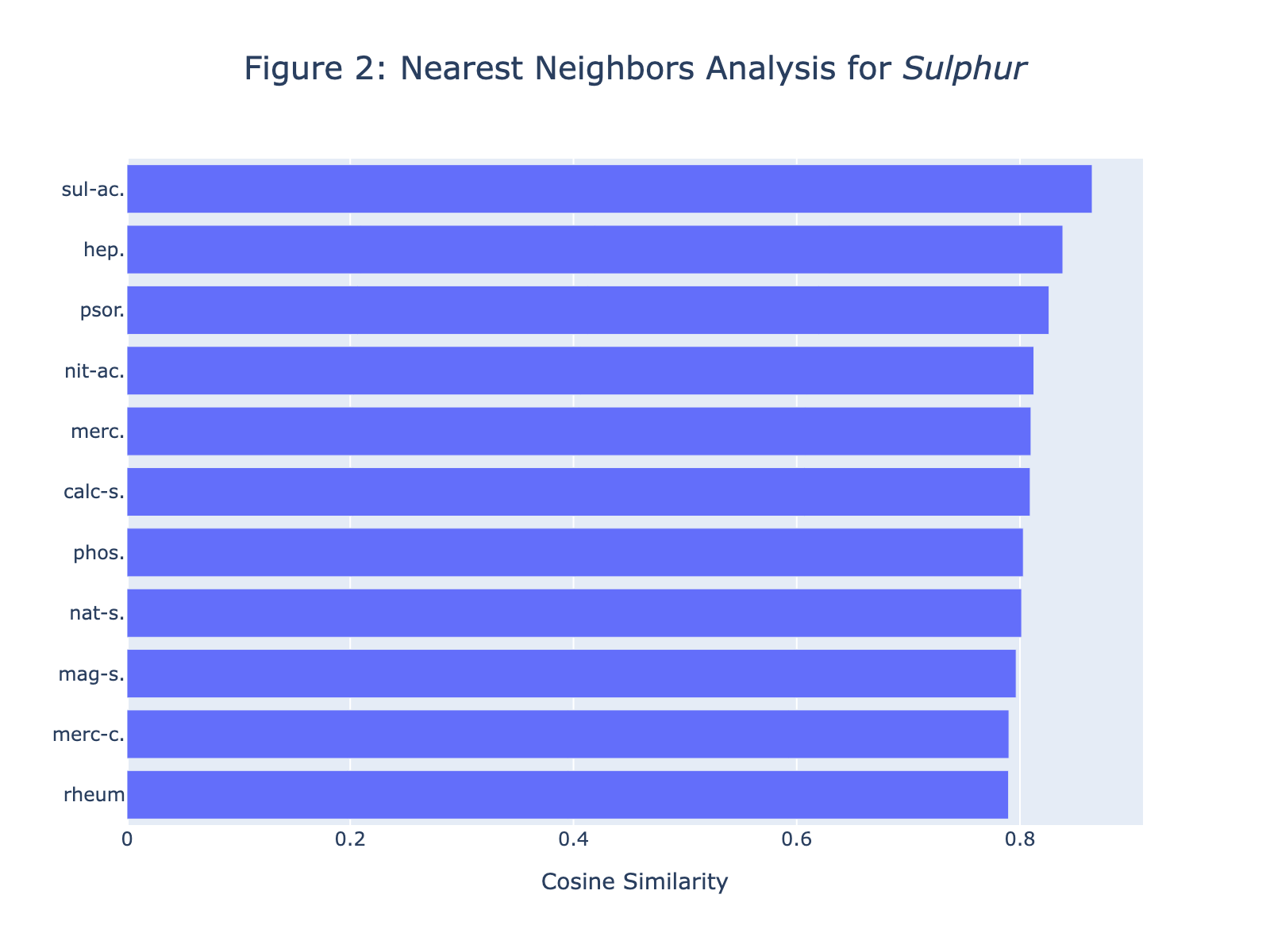
Figure 2: A nearest neighbor analysis for Sulphur. The remedies are ranked by their cosine similarity in the vector space, revealing its closest semantic relatives. This tool allows for a nuanced exploration of remedy relationships beyond simple repertory lookups.
4.3 Uncovering Deeper Patterns: Vector Arithmetic and Analogies
Perhaps the most profound capability of a well-structured vector space is the ability to perform vector arithmetic. Because the vectors encode meaning, adding or subtracting them can reveal deeper relational patterns. This is often expressed in the form of analogies: “Vector(King) - Vector(Man) + Vector(Woman) ≈ Vector(Queen).”
We can apply this same logic to homeopathy. The research UI allows for the exploration of such analogies. For example, we could ask: “Aconite is to acute fear as Ignatia is to X.” The system calculates this by taking the vector for Ignatia, subtracting the vector for the concept of “acute grief,” and then adding the vector for “acute fear.” The resulting vector’s nearest neighbor is often a remedy that fits the analogy perfectly.
This tool moves beyond simple similarity to explore the functional relationships between remedies and concepts. It allows us to ask complex relational questions and receive answers grounded in the mathematical structure of the entire homeopathic corpus, potentially revealing connections that have not yet been fully articulated in our literature.
These visualization tools transform the static, textual data of our books into a dynamic, interactive landscape of meaning. They provide a new way to study the Materia Medica, not as a collection of individual monographs, but as a deeply interconnected network of relationships.
4.4 Empirical Validation: Does It Work?
The value of this system ultimately depends on whether its mathematically-derived relationships correspond to genuine homeopathic knowledge. A systematic validation analysis was performed on the complete 200-remedy vector space, yielding results that are both validating and scientifically intriguing.
Chemical families show strong, consistent clustering. The most robust validation comes from chemically-related remedy groups. The Kali salts demonstrate exceptional internal coherence, with pairwise similarities ranging from 0.78 to 0.85: Kali carbonicum-Kali nitricum (0.85), Kali carbonicum-Kali bichromicum (0.84), Kali bichromicum-Kali sulphuricum (0.84). This pattern holds across other mineral families: the Natrums, Calcarea, Magnesias, and Carbons all form tight, internally consistent clusters. This is not coincidental: the AI learned these relationships purely from phenomenological descriptions in the Materia Medica, demonstrating that shared chemistry genuinely produces shared symptomatology. Recent data mining research has independently validated that statistical analysis of classical Materia Medica reveals robust correlations and clustering patterns within remedy families, confirming that these computational relationships reflect genuine clinical phenomena rather than random textual artifacts.[4]
To explore this phenomenon more deeply, we can decompose the similarity analysis by embedding type. Recall that the system generates three distinct embeddings for each remedy: an essence-only vector (capturing constitutional themes and core delusions), a keynote-only vector (capturing concrete symptomatology), and a combined vector. By comparing similarity matrices across these three types, we can distinguish between constitutional relationships and phenomenological convergences.
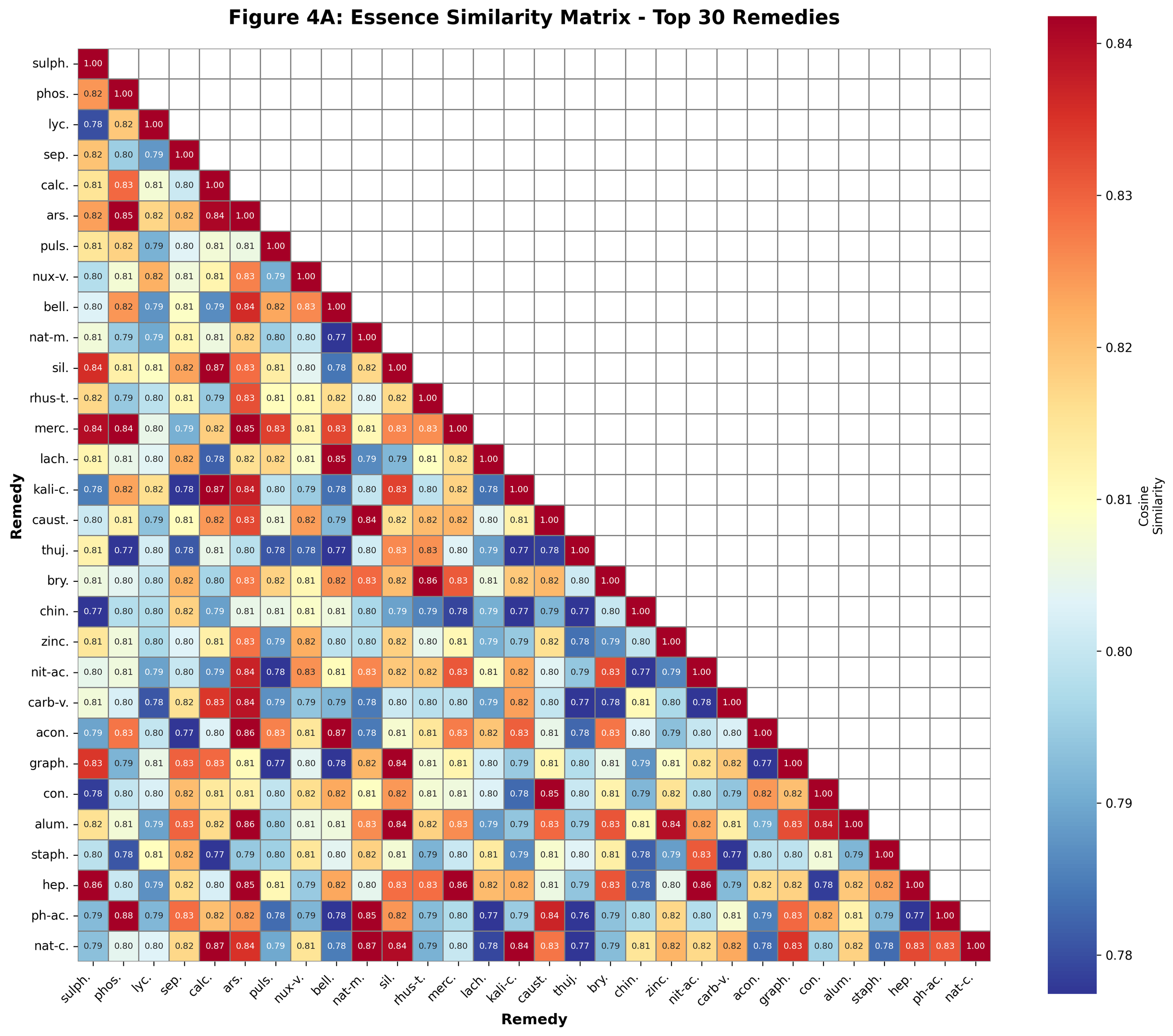
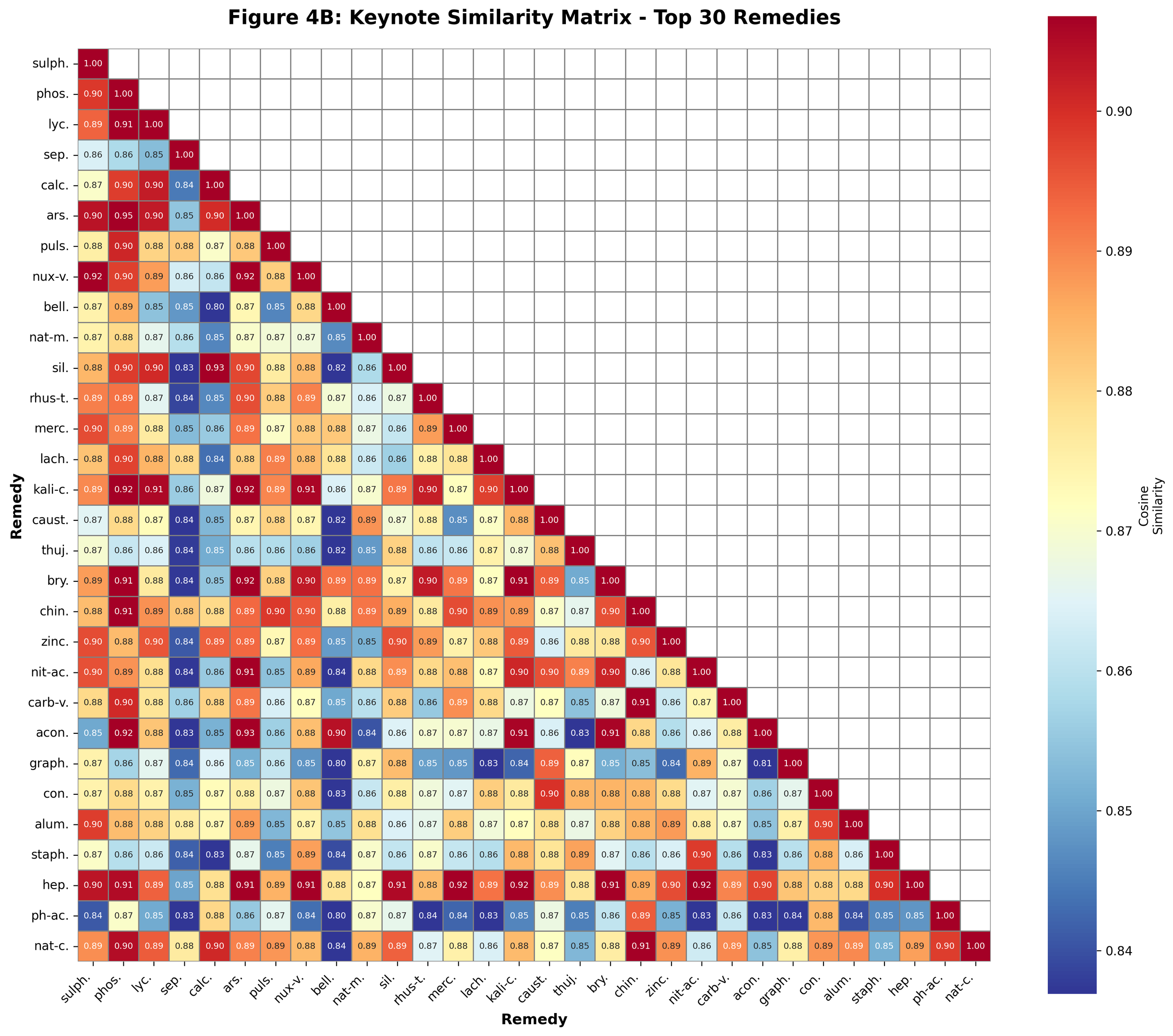
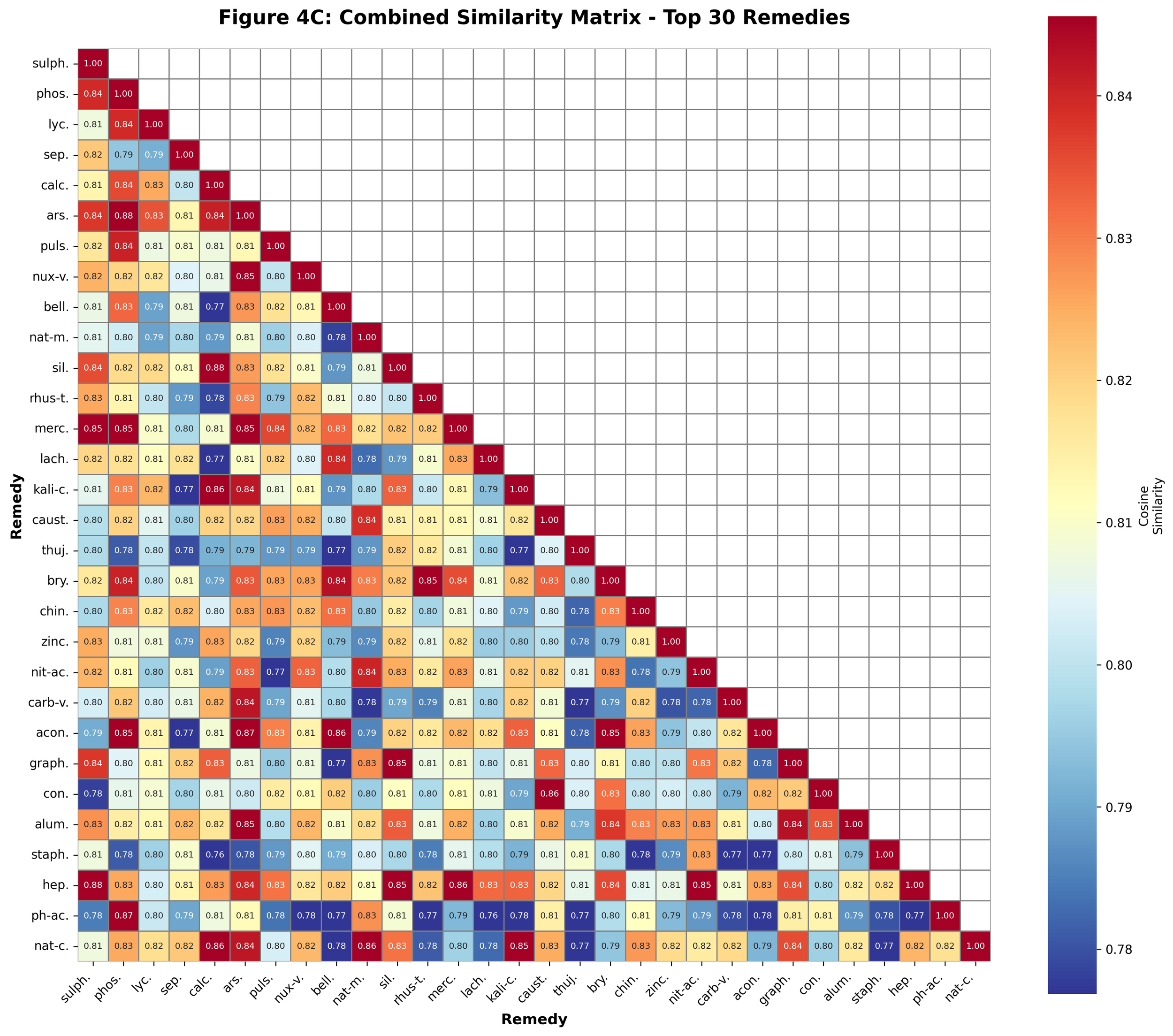
Figure 3: Decomposition of Remedy Similarity by Embedding Type. Three similarity matrices for the top 30 most-documented polychrest remedies. (A) Essence-Only Similarity** (range 0.76-0.88, mean 0.81, σ=0.020) captures constitutional and philosophical relationships. (B) Keynote-Only Similarity (range 0.80-0.95, mean 0.87, σ=0.022) shows higher mean similarity (+8%) with comparable variance, demonstrating that while symptom profiles converge more than constitutional patterns, both dimensions exhibit similar variability. (C) Combined Similarity integrates both dimensions. To properly contextualize these values, we must consider their statistical distributions: truly exceptional pairs (>2σ) reveal distinct patterns. Phenomenological convergence—Phosphorus-Arsenicum (keynote 0.95, z=+3.3σ; essence 0.85, z=+1.9σ) demonstrates remarkable symptom overlap despite different constitutional bases. Constitutional similarity—Phosphorus-Phosphoricum acidum (essence 0.88, z=+3.3σ; keynote 0.87, z=-0.2σ), Calcarea-Silicea (essence 0.87, z=+3.3σ; keynote 0.94, z=+2.8σ), and Calcarea-Kali carbonicum (essence 0.87, z=+3.1σ; keynote 0.87, z=-0.3σ), where chemical relatives share constitutional essence. This decomposition validates the multidimensional nature of remedy relationships: some are constitutionally similar, others symptomatically convergent, and true polychrests balance both.**
Highly similar variations of the same substance validate the model. The strongest similarity scores (>0.85) occur between different preparations or salts of the same base substance: Cannabis indica-Cannabis sativa (0.89), Calcarea phosphorica-Calcarea carbonica (0.88), Aurum metallicum-Aurum muriaticum (0.88), Tuberculinum-Bacillinum (0.88), Mercurius corrosivus-Mercurius solubilis (0.88). This provides strong evidence that the vector space is capturing genuine remedy essence, not random textual patterns.
Phenotypic relationships transcend taxonomy. The most scientifically interesting finding is that not all high-similarity pairs are chemically related. Analysis of the Lachesis vector reveals that its nearest neighbors by combined embedding are not primarily other snake venoms, but rather: Moschus (0.77), Sepia (0.77), Hyoscyamus (0.76), and Coccus cacti (0.76). Other snake remedies like Crotalus horridus (0.74) and Elaps (0.74) rank lower. This suggests that Lachesis shares more phenomenological features—such as themes of jealousy, constriction, left-sidedness, and hormonal sensitivity—with these diverse remedies than it does with its zoological relatives. When we decompose the analysis by embedding type, we see that Lachesis-Apis share an extraordinarily high keynote similarity (0.93), despite being from completely different kingdoms, suggesting a convergent symptomatology around themes of inflammation, left-sided complaints, and aggravation from heat.
This is a profound validation: the AI is not simply learning taxonomy; it is learning the homeopathic principle that “similar symptoms, regardless of source, indicate similar remedies.” The vector space reveals both expected (chemical families) and unexpected (phenotypic convergences) relationships, exactly as one would hope from a system trained on genuine clinical and proving data.
These validation results demonstrate that the semantic vector space is not arbitrary mathematics—it is a structured, verifiable representation of genuine homeopathic knowledge that invites further scientific exploration.
5. From Manual Index to Dynamic Inquiry: The Living Materia Medica
The vector space model described in Sections 3-4 forms the foundation for a new generation of clinical tools. While the research system presented focuses on remedy-to-remedy relationships and Materia Medica exploration, the same underlying technology enables patient-facing applications that are beginning to emerge in the field.
The distinction between repertory and Materia Medica has always been one of structure versus richness. The repertory provides the map, but the Materia Medica describes the territory. AI allows us to merge them into a single, dynamic resource.
Imagine a practitioner entering a patient’s narrative into a software interface: “I’ve had this terrible headache since a grief. It’s a throbbing pain over my right eye that feels like my head will burst. The light hurts my eyes, and I just want to be left alone in a dark room and not move at all.”
An AI-powered system leveraging the technologies we’ve described would not just perform keyword searches. It would:
Convert the Narrative to a Vector: The system would use the same embedding technology employed in the project to convert the patient’s narrative into a semantic vector—a mathematical representation of the symptom-gestalt.
Perform Semantic Search: Using this vector, it would search the entire vector space of remedies. It would identify remedies whose essence vectors are closest to the patient’s symptom vector, finding not just keyword matches but deep phenomenological alignments. It would recognize the conceptual link to Ignatia and Natrum muriaticum from their themes of ailments from grief, and match the “bursting” pain and photophobia to remedies like Belladonna or Bryonia.
Integrate Materia Medica Context: For the top candidates, the system would retrieve and display the relevant portions of their Super-Documents, allowing the practitioner to read the AI’s synthesis of the remedy’s essence and keynotes alongside the original source material.
Generate a Coherence Score: Instead of just counting rubrics, the system would present a list of potential remedies ranked by a “phenomenological coherence score”—a measure of how well the entire pattern of the patient matches the core pathogenetic profile of each remedy. Bryonia might rank highest not because it covers the most isolated symptoms, but because the specific constellation of grief etiology, aggravation from motion, desire for stillness, and irritability forms a unified, characteristic picture for that remedy.
This is a shift from a static, indexed lookup to a dynamic, conversational query of our entire literature. It bridges the gap between the atomized symptoms of the repertory and the holistic picture of the Materia Medica.
This AI-driven approach represents a profound shift in our interaction with homeopathic knowledge. It transforms our static, indexed library into a dynamic, conversational partner. It allows us to move from the laborious, often incomplete process of manual repertorization to a fluid, intuitive dialogue with the totality of our literature. The practitioner’s focus is elevated from mechanical cross-referencing to the higher-order task of verifying the AI’s suggestions against their own clinical acumen and the patient’s living presentation.
5.1 Unsupervised Pattern Discovery: Discovering the Hidden Materia Medica
Beyond enhancing case analysis, these same AI tools can be turned loose on vast archives of clinical data to discover patterns we have not yet formalized. Using clustering algorithms—a form of unsupervised machine learning—an AI can analyze thousands of digitized successful cases for a remedy like Sepia. It could identify a recurring constellation of five or six symptoms that, while not currently grouped in any single rubric, are statistically powerful predictors of a positive outcome for Sepia.
This is not just about finding new symptoms; it is about discovering the gestalts that veteran homeopaths perceive through intuition and decades of experience. It is a method for making that implicit knowledge explicit. AI can serve as a computational microscope, revealing the hidden structures and clinical keynotes that lie dormant within our collective case data. It allows for the data-driven discovery and validation of new clinical wisdom, enabling the Materia Medica to grow and refine itself based on the continuous feedback of real-world clinical results.
6. A New Paradigm for Homeopathic Evidence: Embracing Complexity
One of the most persistent challenges facing homeopathy is the demand for evidence from a biomedical model that is often profoundly ill-suited to its methodology. The Randomized Controlled Trial (RCT), held up as the “gold standard,” is built on a foundation of homogeneity. It requires a uniform diagnosis (e.g., “major depressive disorder”) and a standardized intervention (e.g., “Remedy X”). This model is designed to find a single key that fits a single lock.
This paradigm is fundamentally at odds with homeopathy’s core principle of individualization. For a homeopath, ten patients with a “migraine” diagnosis may represent ten entirely different phenomenological states, requiring ten different remedies (Belladonna, Sanguinaria, Iris versicolor, etc.). Forcing them all into one treatment arm to test a single remedy against a placebo is not a valid test of homeopathy; it is a test of a non-homeopathic application of a homeopathic medicine. It is an experimental design that guarantees failure by ignoring the very principle it purports to investigate.
AI, and the vector space model in particular, allows us to forge a new path for evidence generation—one that embraces, rather than rejects, complexity and individualization. This is the paradigm of Real-World Evidence (RWE), analyzed using sophisticated causal inference methods.
Imagine a global, anonymized database where thousands of practitioners contribute their cases in a structured format: the patient’s full narrative, the vector representation of their symptom-gestalt, the prescription given, and the detailed outcomes over time. This vast dataset of real-world practice becomes our laboratory.
6.1 Causal Inference: Finding the Signal in the Noise
How can we confidently know a remedy worked without a placebo group? Causal inference is a branch of statistics and AI designed to answer precisely this question by analyzing observational data. One of the most powerful techniques is propensity score matching.
Let’s say a patient (Patient A) presents with a unique symptom profile, is given Natrum muriaticum, and experiences significant improvement. To assess causality, the AI would first convert Patient A’s symptom-gestalt into a vector in our semantic space. It would then scan the entire database of thousands of cases to find a group of “digital twins”—other patients whose symptom vectors are nearly identical to Patient A’s. These are patients who had the same phenomenological pattern (the same grief, the same headaches, the same modalities) but who, for whatever reason, did not receive Natrum muriaticum. They may have received a different remedy, placebo, or no treatment at all.
By comparing Patient A’s outcome to the average outcome of their untreated doppelgängers, we can computationally estimate the specific effect of the intervention, isolating it from natural history or placebo effects. When this is done for thousands of Natrum muriaticum cases, we can build a statistically robust picture of the remedy’s specific effect on specific, high-resolution patient profiles.
6.2 From Vague Diagnosis to Precision Phenotype
This AI-driven approach allows us to transcend the limitations of conventional diagnostic labels. Instead of asking the crude question, “Does Sulphur work for eczema?,” we can define a mathematically precise symptom phenotype.
A phenotype like “Eczema-S1” is no longer just a narrative description; it is a specific region in the high-dimensional vector space. It is a cluster of vectors defined by characteristics like: chronic eczema with intense itching and burning, worse from warmth and washing, a history of suppressed eruptions, a craving for sweets, and morning irritability.
The research question thus becomes: “For patients whose symptom vector falls within the Eczema-S1 region of the semantic space, what is the probability that a prescription of Sulphur will lead to a significant improvement?”
P(Success|Remedy=Sulphur,Patient VectorPhenotype-S1)
This is a question that is both scientifically rigorous and perfectly aligned with the homeopathic method. It generates evidence that is directly applicable at the bedside, respecting the profound complexity and individuality that has always been the hallmark of our discipline. It allows us to study homeopathy on its own terms.
This approach does not merely offer an alternative to the RCT; for an individualized medicine, it offers a superior path. It generates evidence that is more granular, more clinically relevant, and more aligned with the fundamental principles of our practice. It moves us from the impossible task of proving a remedy works for a diagnosis to the practical and achievable goal of demonstrating which remedy works for which specific kind of patient.
7. Epistemological Implications and Responsible Implementation
Adopting an AI-driven paradigm is not merely a technological upgrade; it is an epistemological shift. It allows homeopathy to be studied through a lens that is native to its own principles, validating its focus on the totality of symptoms and the sanctity of the individual case. This approach reframes the “anecdotal” single case not as weak evidence, but as an immensely rich data point that, when aggregated with thousands of others, becomes a powerful source of verifiable knowledge.
However, this powerful new toolkit must be wielded with wisdom and foresight. The transition requires a conscious and community-wide commitment to responsible implementation.
7.1 Addressing Counterarguments: Challenges and Limitations
Before outlining the principles of responsible implementation, it is essential to directly confront the most common counterarguments and acknowledge the genuine limitations of this approach.
“AI is a ‘black box’ that undermines homeopathic understanding.” This is a valid concern, but not an insurmountable one. The transparency of AI systems exists on a spectrum. While some deep learning models can be opaque, many of the techniques described in this paper—semantic search via embeddings, nearest neighbor analysis, and propensity score matching—are fundamentally interpretable. We can see which remedy vectors are closest to a patient’s symptom vector and understand why mathematically. The key is to prioritize Explainable AI (XAI) methods and to always present the practitioner with not just a recommendation, but the reasoning and source material behind it. AI should augment, not obscure, clinical reasoning.
“This approach requires massive amounts of high-quality data that don’t yet exist.” This is perhaps the most substantial practical challenge. The effectiveness of the proposed evidence paradigm depends on large-scale, structured clinical data collection, which is not yet a widespread practice in homeopathy. However, this is not an argument against the paradigm; it is an argument for beginning that work now. The technology exists. The bottleneck is organizational, not technical. Moreover, the case study demonstrates that even with imperfect data (historical texts, not real-world outcomes), AI can extract meaningful patterns. The vector space project transformed narrative texts into a structured, queryable system—proving the feasibility of the approach.
“AI will lead to the standardization and de-individualization of homeopathy.” This is a misunderstanding of the proposal. The entire premise of the vector space model is to capture and operationalize individualization, not eliminate it. By representing each patient as a unique point in semantic space, we move toward precision, not away from it. The concern would be valid if we were proposing to use AI to create rigid treatment protocols based on diagnoses. We are proposing the opposite: to use AI to manage the complexity that individualization demands.
“Why should we trust machines over centuries of clinical wisdom?” We should not. This is not a question of trust; it is a question of augmentation. The AI systems described here are trained on and operate within the framework of that very clinical wisdom. The LLM that synthesizes remedy essences is doing so by analyzing the writings of Hahnemann, Kent, Hering, and countless other masters. The vector space is built from our Materia Medica. AI is not replacing that wisdom; it is making it more accessible, more queryable, and more systematically verifiable.
“Doesn’t AI’s mathematical pattern recognition fundamentally conflict with homeopathy’s hermeneutic, interpretive nature?” This is perhaps the most philosophically sophisticated objection, and it deserves a nuanced response. Homeopathy is indeed a hermeneutic practice—it requires interpretation of meaning, not just matching of data points. However, this is not incompatible with computational methods; it is complementary to them. The hermeneutic process begins with perception and understanding, which can be aided by computational tools that surface relevant patterns and relationships. The mathematical representation of semantic meaning (embeddings) does not eliminate interpretation; it enables it at scale. A practitioner still reads the case, still perceives the gestalt, still makes the interpretive leap to the simillimum. What changes is that they now have an intelligent tool that can instantly surface which remedies share deep semantic features with the patient’s presentation—a task that would take hours manually. The final act of clinical judgment remains irreducibly human and hermeneutic, but the preparatory work of literature search and pattern recognition can be augmented. We are not replacing hermeneutics with computation; we are using computation to support hermeneutics.
These limitations are real, substantial, and should not be minimized. The path from this proof-of-concept to a fully operational, clinically integrated system will require years of sustained effort, significant financial investment, resolution of complex data governance issues, and widespread cultural change within the homeopathic community. The technical feasibility has been demonstrated, but the organizational, ethical, and practical challenges of implementation remain formidable. This is a multi-decade project, not a quick technological fix. However, the magnitude of these challenges is not an argument for inaction—it is an argument for beginning now, systematically and thoughtfully, with realistic expectations and a commitment to rigorous, incremental progress.
The Primacy of Data Quality (Garbage In, Garbage Out): An AI system is a mirror that reflects the quality of the data it is shown. If our clinical data is imprecise, incomplete, or biased, the AI’s conclusions will be equally flawed. This calls for a renewed, community-wide effort to develop and adopt rigorous standards for case reporting and data collection, ensuring a foundation of high-quality, reliable inputs.
Navigating the “Black Box” (Explainable AI): Some complex AI models can be opaque, delivering a highly accurate prediction without revealing the “why” behind it. For a discipline like homeopathy, where understanding the rationale is paramount, this is unacceptable. It is crucial that we prioritize and develop Explainable AI (XAI) methods that allow practitioners to scrutinize and understand a model’s reasoning, ensuring it aligns with homeopathic philosophy and is not just a statistical artifact.
The Irreplaceable Clinician: It must be stated unequivocally: AI is a decision-support tool, not a decision-maker. It is a brilliant, tireless assistant that can analyze the entire library of homeopathic knowledge in seconds and highlight patterns invisible to the human eye. However, it cannot replicate the uniquely human capacities for empathy, intuition, presence, and the establishment of a therapeutic relationship, which are often the very heart of healing. The homeopathic consultation is characterized by narrative competence and careful listening to grasp the overall meaning of suffering. Generative AI, lacking internal motivation and true self-awareness, can assist but cannot replace this fundamentally human dimension of healing.[5,6] A recent comparative study of AI-powered acute prescribing found that while automated tools achieved remedy overlap with practitioners in 59% of cases, they could not replicate the nuanced case management, remedy response handling, and individualized guidance that characterizes expert practice.[6] The final judgment, the art of the prescription, must always rest with the conscious, discerning clinician.
Guarding Against Encoded Bias: AI models learn from the data they are given, and in doing so, they can inadvertently learn and amplify the biases present in that data. If certain remedies have been historically over-prescribed for certain conditions, or if our collected case data over-represents specific demographics or geographical regions, the AI will learn these skews as normative. A conscious, continuous effort is required to curate datasets that are diverse, representative, and clean of historical artifacts to ensure our AI tools are equitable and objective.
8. Conclusion: From Vision to Action
Artificial Intelligence is not merely a new technology; it is a new lens through which we can perceive and analyze the vast, intricate tapestry of homeopathic knowledge. It is a class of tool uniquely suited to our discipline’s inherent complexity and its profound focus on semantic patterns. By embracing AI, we are not abandoning our roots; we are building a more powerful engine to explore them. The case study presented in this paper is not theoretical speculation—it is working software, processing real data, generating actionable insights today.
We stand at a critical juncture. Homeopathy faces persistent challenges in evidence generation, knowledge management, and integration with modern healthcare systems. AI offers not just incremental improvements but a fundamental transformation in how we approach these challenges. The vector space model demonstrates that our vast, narrative literature can be mathematically structured without losing its richness. The proposed evidence paradigm shows that individualization—long considered a methodological weakness in the eyes of conventional research—can be operationalized as a methodological strength.
We envision a future where every homeopathic practitioner is a node in a global, collaborative learning network. A future where the Materia Medica and Repertory are not static books on a shelf, but a single, living entity—constantly refined, updated, and enriched in near real-time by anonymized, high-quality clinical data from around the world. A system where a young practitioner in a remote village can pose a complex clinical question and receive an answer informed by the distilled experience of thousands of colleagues. A community where the successful treatment of their patient, in turn, contributes back to the collective, ever-growing knowledge base, sharpening our collective understanding.
This is not a distant, speculative dream; the foundational technology exists and has been demonstrated. The journey of a thousand miles begins with a single step. The challenge for our community now is to take that step: to invest in digitization, to establish standards for data collection, to foster a culture of collaboration and data sharing, and to build the infrastructure that will allow AI to illuminate the profound truths of homeopathy for generations to come. The tools are ready. The question is not whether this transformation is possible, but whether we have the collective will to pursue it.
By integrating these powerful new tools, we do not sacrifice the art of homeopathy; we enhance it. We honor our tradition by making its accumulated wisdom more accessible, more verifiable, and more applicable. We serve our patients by bringing the best of our heritage together with the best of modern technology. The future of homeopathy is not a choice between tradition and innovation: it is the synthesis of both.
References
Bellavite P, Ortolani R, Pontarollo F, Pitari G, Conforti A. Immunology and Homeopathy. 5. The Rationale of the ‘Simile’. Evid Based Complement Alternat Med. 2007;4(2):149-163. DOI: 10.1093/ecam/nel117.
Singh SR, Patil AD. Natural Language Processing (NLP) as an Artificial Intelligence Tool and its Scope in Prognostic Factor Research Model in Homeopathy. Indian J Integr Med. 2024;4(2):35-40.
Singh SR, Patil AD. Bridging the Gap between Artificial Intelligence and Ancestral Intelligence in Conventional Medicine and Homeopathy. Indian J Integr Med. 2024;4(2):66-70.
Schäferkordt R. Data Mining in Homeopathic Materia Medica. Homeopathy. 2025. DOI: 10.1055/a-2591-4676.
Tarro G, De Giorgio G. Artificial Intelligence Can Assist the Homeopath, But It Cannot Replace Him: Listening to a Doctor is Different from Listening to a Robot. Br J Healthcare Med Res. 2025;12(1):93-97. DOI: 10.14738/bjhr.1201.18170.
Doherty R, Pracjek P, Luketic CD, Straiges D, Gray AC. The Application of Artificial Intelligence in Acute Prescribing in Homeopathy: A Comparative Retrospective Study. Healthcare. 2025;13(15):1923. DOI: 10.3390/healthcare13151923.
Glossary of Technical Terms
Artificial Intelligence (AI): The field of computer science focused on creating systems capable of performing tasks that typically require human intelligence, such as pattern recognition, language understanding, and decision-making.
Causal Inference: Statistical methods used to determine cause-and-effect relationships from observational data, allowing researchers to estimate treatment effects without randomized controlled trials.
Clustering Algorithm: A machine learning technique that automatically groups similar data points together based on their characteristics, used to discover hidden patterns in large datasets.
Cosine Similarity: A mathematical measure of similarity between two vectors in high-dimensional space, ranging from 0 (completely different) to 1 (identical), used to quantify semantic relationships between remedies or symptoms.
Embedding / Word Embedding: A technique that represents words, phrases, or documents as numerical vectors in high-dimensional space, where semantically similar items are positioned close together, enabling computers to understand meaning and context.
Explainable AI (XAI): AI systems designed to provide transparent, interpretable explanations for their decisions and recommendations, allowing practitioners to understand the reasoning behind computational outputs.
Knowledge Graph: A network structure representing information as interconnected nodes (entities) and edges (relationships), allowing flexible exploration of complex data relationships beyond traditional hierarchical databases.
Large Language Model (LLM): An AI system trained on vast amounts of text data that can understand, generate, and analyze human language, capable of sophisticated tasks like summarization, synthesis, translation, and pattern recognition.
Natural Language Processing (NLP): A branch of artificial intelligence that enables computers to understand, interpret, and generate human language in a meaningful way, transforming unstructured text into analyzable data.
Nearest Neighbor: An algorithm that identifies the most similar items to a given data point based on distance metrics in vector space, used to find remedies with similar phenomenological characteristics.
Propensity Score Matching: A statistical technique that creates comparable groups from observational data by matching individuals with similar baseline characteristics, enabling causal inference and treatment effect estimation without randomization.
Real-World Evidence (RWE): Clinical evidence derived from analysis of real-world data collected outside of traditional randomized controlled trials, including electronic health records, patient registries, and routine clinical practice data.
Semantic Search: A search technique that understands the meaning and context of queries rather than just matching keywords, enabling retrieval of conceptually relevant results even when exact terminology differs.
t-SNE (t-Distributed Stochastic Neighbor Embedding): A dimensionality reduction algorithm that projects high-dimensional data into 2D or 3D space while preserving local neighborhood relationships, making complex data structures visible and interpretable.
Transformer: A neural network architecture that uses attention mechanisms to process sequential data by weighing the importance of different parts of the input simultaneously, forming the foundation of modern large language models.
UMAP (Uniform Manifold Approximation and Projection): A dimensionality reduction technique similar to t-SNE but often faster and better at preserving both local and global structure in data visualization.
Vector / Vector Space: A mathematical representation where items (words, symptoms, remedies) are encoded as lists of numbers (vectors) in multi-dimensional space, enabling computational analysis of semantic relationships through geometric operations.
Appendix: Complete Embedded Remedy Texts
This technical appendix provides the exact, literal texts that were embedded to create the vector space. These are the AI-synthesized essences and keynotes generated by google/gemini-2.5-pro and subsequently converted to 3072-dimensional vectors by gemini-embedding-001.
A. Data Pipeline Overview
Input Data for Each Remedy:
Materia Medica Texts: All available texts from digitized classical sources (Boericke, Clarke, Hering, Kent, Murphy, and others), aggregated into a single comprehensive document.
Characteristic Repertory Rubrics: Filtered to include only the most defining symptoms (all Grade 3/4 rubrics, plus Grade 2 rubrics appearing in <15 remedies).
This consolidated data (tens of thousands of words per remedy) is submitted to google/gemini-2.5-pro with the following prompt:
Synthesis Prompt: > “You are an expert homeopathic scholar. Analyze the provided data and produce: (1) REMEDY ESSENCE - a 3-5 sentence narrative capturing the central genius and pattern; (2) KEYNOTE SYMPTOMS - a bulleted list of 5-10 most characteristic symptoms; (3) ARCHETYPAL PATIENT - a short paragraph describing the constitutional type. Focus on what makes this remedy unique.”
Each synthesis is then embedded separately (essence alone, keynotes alone, and combined) using gemini-embedding-001 to generate three 3072-dimensional vectors.
B. The Kali Family (9 Remedies)
KALI ARSENICUM (kali-ar.)
REMEDY ESSENCE (Embedded Text)
Kali arsenicosum embodies the fusion of Kali’s rigid sense of duty and order with Arsenicum’s profound anxiety, restlessness, and fear of death. Its central action is on the skin, blood, and nervous system, producing deep-seated, often malignant, pathological states. The underlying pattern is one of profound insecurity and hypochondriacal fear, especially of heart disease, driving a state of meticulous but desperate internal chaos, marked by an aggravation after midnight and a paradoxical combination of deep chilliness with skin symptoms that are worse from warmth.
KEYNOTE SYMPTOMS (Embedded Text)
Overwhelming anxiety and fear, especially of having a heart attack, stroke, or cancer.
Mental and physical restlessness, with symptoms worse at night, particularly between 1 a.m. and 3 a.m.
Chronic, inveterate skin diseases like psoriasis and eczema, with dry, scaly skin and intolerable itching, aggravated by warmth and upon undressing.
Profound chilliness and sensitivity to cold air and drafts; cannot get warm enough, even in summer.
Asthma with difficult, anxious respiration, obliging them to sit up, characteristically worse after midnight (1-3 a.m.).
Burning pains are a general feature, felt in ulcers, the stomach, or the anus during diarrhea.
Mentally rigid, obstinate, suspicious, and intolerant, often becoming morose and quarrelsome.
Anxious preoccupation with health; talks constantly about their diseases and impending doom.
Diarrhea, often watery and offensive, driving them from bed after midnight.
Gouty nodosities and rheumatic pains, worse with changes in the weather.
KALI BICHROMICUM (kali-bi.)
REMEDY ESSENCE (Embedded Text)
Kali bichromicum centers on the formation of thick, tenacious, and stringy exudates on all mucous membranes, a physical manifestation of a mentally rigid and conformist nature. Its sphere of action is deep and destructive, producing deep, “punched-out” ulcers and affecting fibrous tissues and bones. The remedy’s pattern is one of slow, indolent processes marked by wandering pains in small spots, sudden onset and disappearance of symptoms, and a distinct alternation of complaints, such as rheumatism with gastric or catarrhal affections. It is a cornerstone for ailments of the sinuses, throat, and bronchi, especially when characterized by its signature ropy discharges.
KEYNOTE SYMPTOMS (Embedded Text)
Discharges from any mucous membrane are thick, tough, ropy, and stringy, especially yellow-green mucus from the nose or chest that can be drawn into long strings.
Pains appear in small, well-defined spots that can be covered with the tip of a finger.
Pains wander from one part to another, and appear and disappear suddenly.
Alternating complaints, especially rheumatism alternating with gastric symptoms or dysentery.
Deep, round ulcers that look as if “punched out,” occurring on the skin, in the throat, stomach, or perforating the nasal septum.
Sensation of pressure, fullness, and pain at the root of the nose, characteristic of sinusitis, often worse from suppressed catarrh.
Formation of hard, dry, elastic plugs (“clinkers”) in the nose, which are difficult to dislodge and leave a raw surface.
Blindness or blurred vision precedes the headache; vision improves as the headache worsens.
Cough is harsh and croupy, with difficult expectoration of stringy mucus, often with pain from the sternum through to the back.
The uvula is oedematous and swollen, appearing like a “bag of water.”
KALI BROMATUM (kali-br.)
REMEDY ESSENCE (Embedded Text)
Kali Bromatum centers on a profound depression and enfeeblement of the central nervous system, producing a state of mental and physical collapse. Its core struggle involves deep-seated guilt, often paranoid and religious in nature, which drives a duality of chaotic restlessness or functional paralysis. This inner torment manifests as constant, fidgety motion of the hands, night terrors, and mania, alternating with profound memory loss, aphasia, impotence, and anaesthesia of mucous membranes. The ultimate expression of this breakdown is seen in severe convulsions, deep melancholic delusions, and intractable pustular acne.
KEYNOTE SYMPTOMS (Embedded Text)
Constant, restless, fidgety motion of the hands and fingers; must keep them busy or wring them.
Profound religious melancholy with a delusion of being singled out for divine punishment or that he is the object of God’s vengeance.
Night terrors in children, who wake screaming, are unconscious of their surroundings, cannot recognize anyone, and may have strabismus afterward.
Complete loss of memory, especially for words; amnesic aphasia where one forgets how to talk and must be told the word before they can speak it.
Bluish-red, pustular acne on the face, chest, and shoulders, often leaving scars, especially in fleshy, young individuals.
Epilepsy and convulsions that are aggravated by the new moon, suppressed menses, or follow sexual excesses and fright.
Loss of sensibility and anaesthesia of the skin and mucous membranes, especially of the throat, larynx, and urethra, making swallowing liquids difficult.
Paranoid delusions of being pursued by enemies or police, of conspiracies against him, or an intense fear of being poisoned.
KALI CARBONICUM (kali-c.)
REMEDY ESSENCE (Embedded Text)
Kali carbonicum embodies the breakdown of a rigid, structured individual, both mentally and physically. These conservative, dogmatic, and duty-bound people rely on control for security, but this brittle exterior crumbles under stress, revealing profound anxiety, irritability, and fear. This internal state manifests physically through extreme chilliness, debilitating weakness, and a keynote of sharp, stitching pains that feel like needles or splinters. The remedy’s action is deep, affecting fibrous tissues and leading to serious pathology in the lungs (especially the right lower lobe), heart, and joints, with a hallmark aggravation in the dead of night, between 2 and 4 AM.
KEYNOTE SYMPTOMS (Embedded Text)
Sharp, stitching, stabbing pains, as if from a knife or needle, that are often wandering and worse during rest.
Overwhelming aggravation of all complaints between 2 and 4 AM, especially cough, asthma, and insomnia.
Peculiar bag-like, edematous swelling of the upper eyelids, between the brow and the lid.
Extreme hypersensitivity; cannot bear to be touched, starts from the slightest touch (especially on the feet), and is intensely averse to cold air and drafts.
The triad of profound weakness, profuse sweat, and a debilitating backache, as if the back would break; especially after loss of fluids like childbirth.
Anxiety, fear, and the effects of shock are felt intensely in the pit of the stomach.
A key mental conflict: desires company but treats family or companions outrageously and quarrelsomely.
Asthma and dyspnea are characteristically relieved by sitting up and leaning forward with elbows resting on the knees.
Pains and inflammation are often localized in the lower part of the right lung.
Sensation of the back “giving out” while walking, with pain extending from the lumbar region down into the buttocks and thighs.
KALI CHLORICUM (kali-chl.)
REMEDY ESSENCE (Embedded Text)
Kali chloricum is a potent and destructive remedy, acting like an aggressive poison on the system, primarily targeting the mucous membranes of the mouth, throat, and the renal parenchyma. Its essence is one of rapid, septic disorganization, producing intense inflammation that quickly progresses to ulceration, gangrene, and necrosis. This violent process is marked by a state of profound prostration, internal coldness as if the blood were turning to ice, and a characteristic milky-white or albuminous quality to all discharges, reflecting the deep tissue decay. It corresponds to low, septic states like diphtheria, nephritis, and stomatitis where the vital force is overwhelmed by a swift, toxic onslaught.
KEYNOTE SYMPTOMS (Embedded Text)
Acute, ulcerative, and gangrenous stomatitis (noma), with the entire mucous surface being red, tumid, and covered in gray-based ulcers.
Violent, destructive nephritis with albuminuria and hematuria, often occurring concurrently with severe mouth or throat pathology.
The tongue is enormously swollen, sometimes filling the entire mouth, and may be cold to the touch.
All discharges from mucous membranes are profuse, tenacious, sticky, and characteristically milky-white (leucorrhea, expectoration, stool).
Dysentery with extreme, knife-like cutting pains in the rectum during stool, causing the patient to cry out; stools may be pure blood or greenish mucus.
Profound internal coldness and chilliness, as if the blood were cooled off, with a peculiar and specific sensation of coldness in the precordial region.
The skin has a dusky, cyanotic, or chocolate-colored tint, particularly on the lips and extremities, indicating a state of sepsis and blood disorganization.
Complete prostration, apathy, and collapse, with a refusal to eat or drink.
KALI IODATUM (kali-i.)
REMEDY ESSENCE (Embedded Text)
Kali iodatum embodies a deep, destructive, syphilitic process, acting profoundly on glands, periosteum, and connective tissues, leading to either induration and swelling or atrophy and ulceration. Its central genius is a paradoxical state of intense internal heat and restlessness, creating an aversion to all warmth and a compelling, almost desperate, need for constant motion in the cool, open air. This physical turmoil is mirrored mentally by extreme irritability, harshness, and cruelty, often directed at family, alternating with profound sadness and anxiety. The remedy is a primary antidote to the effects of chronic mercurial poisoning and is indicated in deep-seated rheumatic, scrofulous, and syphilitic complaints with nightly aggravations.
KEYNOTE SYMPTOMS (Embedded Text)
Profound amelioration from motion and in the cool, open air; extreme aggravation from heat, warm rooms, touch, and from rest.
Severe, gnawing, boring bone and periosteal pains (especially tibia, cranium) and sciatica, all dramatically worse from sunset to sunrise and from lying on the painful side.
Extreme irritability, cruelty, and harshness directed towards one’s own family and children, who become burdensome.
Profuse, acrid, watery coryza with intense pain at the root of the nose and frontal sinuses, triggered by the slightest cold or dampness.
Thick, copious, greenish expectoration, often described as looking like soap-suds, in pneumonia or bronchitis.
Induration and swelling of glands (thyroid, submaxillary) or, conversely, atrophy of glands (mammae, testes).
Marked chemosis (puffy, watery swelling of the conjunctiva), often accompanying coryza or in syphilitic iritis.
KALI NITRICUM (kali-n.)
REMEDY ESSENCE (Embedded Text)
Kali Nitricum primarily targets the respiratory and cardio-renal systems, producing sudden, violent inflammatory states characterized by intense constriction. Its central genius revolves around a suffocating dyspnea, sharp stitching pains, and a profound sense of internal tension that manifests as a peculiar paralytic numbness. This pattern extends to sudden dropsical swellings and dark, ink-like hemorrhages, reflecting a state of acute, debilitating crisis with underlying weakness and anxiety.
KEYNOTE SYMPTOMS (Embedded Text)
Asthma with excessive dyspnea, so severe the patient cannot hold their breath long enough to drink, despite being thirsty; must drink in quick sips.
Menses are profuse, too early, and the blood is characteristically black as ink, accompanied by violent backache.
A peculiar sensation as if affected parts are made of wood; a stiff, thick, numb feeling in the limbs or abdomen.
Sudden and rapidly developing dropsical swellings over the whole body.
Violent complaints, especially diarrhea, colic, or headache, after eating veal.
Cough or asthmatic attacks that awaken the patient around 3 a.m., with sharp stitching pains in the chest.
Sharp, stitching pains in the chest, compelling the patient to sit up; worse lying with the head low.
Great anxiety and fear of impending death, which is significantly worse when alone.
KALI PHOSPHORICUM (kali-p.)
REMEDY ESSENCE (Embedded Text)
Kali phosphoricum is the principal remedy for nervous prostration and profound exhaustion arising from overwork, worry, and emotional strain. Its central genius lies in its action on the nerve cells, restoring power to a system depleted by excessive mental exertion or prolonged stress. This collapse manifests as brain-fag, memory loss, and extreme sensitivity, coupled with a deep despondency and irritability. On the physical plane, this state of decay produces septic conditions with putrid, foul-smelling discharges, paralytic weakness, and a characteristic mustard-yellow coating or secretion.
KEYNOTE SYMPTOMS (Embedded Text)
Profound mental and physical prostration from overwork, worry, or grief; the “brain-fag” remedy for students and professionals.
Extreme nervousness and oversensitivity; starts easily from the slightest touch or noise.
All discharges (stool, breath, leucorrhea, sweat) are putrid, foul, and carrion-like.
Tongue is coated brownish-yellow, like dried mustard; excessively dry mouth in the morning.
Discharges are characteristically golden-yellow or orange-colored (nasal, leucorrheal, urinary).
Paralytic weakness, numbness, and trembling in the limbs, often with pain that is ameliorated by gentle motion but aggravated by continued exertion.
Night terrors in nervous, sensitive children; waking from sleep screaming and frightened.
Headaches of worn-out individuals, often in the occiput, relieved by gentle motion and eating.
KALI SULPHURICUM (kali-s.)
REMEDY ESSENCE (Embedded Text)
Kali Sulphuricum governs the third or retrogressive stage of inflammation, addressing torpid conditions where resolution is sluggish. Its genius lies in its profound action on the skin and mucous membranes, producing profuse, distinctly yellow, slimy or thin watery discharges. This underlying pattern of cellular breakdown and secretion is defined by a strong aggravation from all forms of heat, especially in a warm room and in the evening, with a corresponding and intense desire and amelioration from cool, open air. It is a remedy for lingering complaints that fail to clear, characterized by this signature thermal modality and discharge.
KEYNOTE SYMPTOMS (Embedded Text)
Profuse, yellow, slimy or thin, watery discharges from any mucous membrane (nose, ears, chest, vagina).
Marked aggravation from warmth, especially in a warm, stuffy room, and in the evening.
Decisive amelioration from and a strong craving for cool, open air.
Wandering, shifting pains in the joints and limbs, often better for gentle motion.
Loose, rattling cough with abundant, easily expectorated yellow phlegm, worse in a warm room.
Skin conditions with profuse scaling and desquamation, such as yellow, moist dandruff, psoriasis, or late-stage eczema.
Tongue coated with a yellow, slimy film, especially at the base.
Catarrhal deafness and noises in the ear due to Eustachian tube blockage.
C. Complete Embedded Texts: The Natrum Family
NATRUM ARSENICUM (nat-ar.)
REMEDY ESSENCE (Embedded Text)
Natrum Arsenicosum embodies a state of deep-seated catarrhal inflammation fused with profound arsenical anxiety and prostration. Its primary sphere is the respiratory tract and mucous membranes, producing a characteristic “stuffed-up” sensation from the root of the nose down into the chest, often accompanied by oedematous swellings, especially around the eyes. This condition reflects a sycotic miasmatic base overlaid with psoric and syphilitic destruction, manifesting as a chilly, exhausted state with marked nervous restlessness, fearfulness, and a tendency towards deep, debilitating pathologies like miner’s asthma or leukemia.
KEYNOTE SYMPTOMS (Embedded Text)
Sensation of being “stuffed up” in the nose and chest, with a compressive pain at the root of the nose.
Lungs feel dry, as if smoke had been inhaled.
Marked oedema, especially of the orbital region; swollen, puffy eyelids, often stuck together in the morning.
Dark, purplish, cedematous throat, often with surprisingly little pain, and a uvula that hangs down like a water bag.
Profound weakness, lassitude, and exhaustion from the slightest exertion.
Diarrhea, especially after drinking milk; often watery, yellow, and driving the patient out of bed in the morning.
Mentally anxious, easily frightened, restless, and suspicious, with difficulty concentrating.
Chronic, thick, tenacious post-nasal drip of yellow or bluish mucus; crusts form which cause bleeding when removed.
Marked chilliness and sensitivity to cold air, yet some mental symptoms and headaches are better in the open air.
Squamous skin eruptions with thin white scales that itch intensely when the patient gets warm from exercise.
NATRUM CARBONICUM (nat-c.)
REMEDY ESSENCE (Embedded Text)
Natrum carbonicum embodies a state of profound weakness and hypersensitivity on the mental, emotional, and physical planes. Its central genius is an inability to assimilate, whether it be sunlight, food (especially milk), or social and intellectual stimuli, leading to a complete collapse of vitality. This fragile individual is easily overwhelmed by the world, resulting in debilitating exhaustion, chronic digestive complaints, and a sad, withdrawn state. They are chilly and averse to the open air, seeking refuge from a world that is too harsh for their delicate system.
KEYNOTE SYMPTOMS (Embedded Text)
Debilitating weakness, exhaustion, and headaches from exposure to the sun and the heat of summer; chronic effects of sunstroke.
Profound mental weakness from the slightest exertion; inability to think, concentrate, or connect thoughts.
Extreme oversensitivity to noise (e.g., crackling of paper, a slamming door) and music, which may cause sadness, anxiety, or trembling.
Very weak digestion, with dyspepsia, bloating, and diarrhea from the slightest dietary error, with a marked aversion to and aggravation from milk.
Weakness of ankles, causing them to turn, sprain, or dislocate easily; the foot bends under while walking.
Aversion to society and even one’s own family; feels an estrangement or division between self and others, yet may fear being alone.
An all-gone, empty feeling in the stomach around 10-11 a.m., which is temporarily relieved by eating.
Anxiety, restlessness, and an overall aggravation of symptoms during a thunderstorm.
Thick, yellow, offensive catarrh that must be hawked from the posterior nares.
NATRUM MURIATICUM (nat-m.)
REMEDY ESSENCE (Embedded Text)
Natrum Muriaticum is the remedy of deep, silent grief and the physical consequences of emotional suppression. Its central genius lies in ailments arising from disappointment, loss, and mortification, where the patient builds a protective wall against further hurt, becoming introverted and averse to consolation. The remedy’s sphere of action profoundly disturbs the body’s fluid balance, manifesting as either extreme dryness of mucous membranes and skin with great thirst, or as profuse, watery, egg-white-like discharges. This pattern of emotional and physical inanition results in a state of emaciation despite a good appetite, reflecting a soul starving from a lack of emotional nourishment.
KEYNOTE SYMPTOMS (Embedded Text)
Ailments from grief, disappointed love, fright, or mortification; dwells on past disagreeable occurrences.
Sad, weeping mood, particularly when alone, but becomes angry or irritable when offered consolation.
Intense craving for salt and salty foods, with a marked aversion to bread, fats, and slimy foods.
Great emaciation, which is most noticeable in the neck, while eating well or having a ravenous appetite.
Severe, throbbing, hammering headaches, often occurring periodically from sunrise to sunset or starting around 10-11 a.m., sometimes preceded by partial blindness or zigzag lights.
Extreme dryness of mucous membranes (mouth, lips, vagina, rectum) with unquenchable thirst for large quantities of water.
Herpetic eruptions (“fever blisters” or “cold sores”) appearing like pearls around the lips and corners of the mouth, especially during fever or following emotional upset.
Mapped tongue with red, insular patches, or a sensation of a hair on the tongue.
Backache that is significantly ameliorated by lying on something hard or by firm pressure against the back.
Constipation with hard, dry, crumbling stools that cause tearing and bleeding of the anus.
NATRUM PHOSPHORICUM (nat-p.)
REMEDY ESSENCE (Embedded Text)
Natrum phosphoricum is the paramount remedy for the acid diathesis, correcting a state of sourness that pervades the entire being. Its genius lies in its ability to address metabolic disturbances from an excess of lactic acid, often triggered by a diet rich in sugar and milk or by nervous exhaustion from mental exertion and sexual excess. The sphere of action is centered on the gastrointestinal tract, nervous system, and joints, manifesting as sour discharges, nervous debility, and a characteristic creamy-yellow coating on the tongue. It restores balance to the overworked, acidic, and worn-out patient.
KEYNOTE SYMPTOMS (Embedded Text)
A distinct golden-yellow, creamy coating on the base of the tongue and roof of the mouth.
Pervasive sourness: sour eructations, sour vomiting of cheesy or milky masses, sour-smelling stools and sweat.
Ailments from excess milk, sugar, or fats, especially in infants and children (e.g., colic, green “hacked” diarrhea).
Profound weakness and trembling, especially in the back and knees, following seminal emissions or sexual excesses.
Anxiety and fear, worse at night, with delusions of hearing footsteps in the next room; easily startled by noise.
Symptoms of intestinal worms, particularly in children: grinding of teeth during sleep, picking the nose, and intense itching of the anus.
Headaches in students from mental exertion, often accompanied by gastric acidity.
Discharges are typically creamy, honey-colored, or yellow (e.g., from eyes, nose, or vagina).
Icy cold feet during the day that burn intensely at night.
Rheumatism, especially of the knee joints, with cracking of joints on motion.
NATRUM SULPHURICUM (nat-s.)
REMEDY ESSENCE (Embedded Text)
Natrum sulphuricum is the paramount remedy for the “hydrogenoid” constitution, representing the physical and mental consequences of being “water-logged.” Its central genius is an extreme sensitivity to all forms of dampness, triggering ailments in a sycotic individual. It profoundly impacts the hepato-biliary system, gastrointestinal tract, and respiratory passages, producing bilious disturbances, flatulence, and humid asthma. Mentally, it addresses a deep, joyless melancholy and suicidal depression, often arising from head injuries or suppressed grief, where the patient struggles with a loathing of life yet feels duty-bound to endure it.
KEYNOTE SYMPTOMS (Embedded Text)
Ailments and mental states that have never been well since an injury to the head or spine.
Profound aggravation from all forms of dampness: wet weather, damp houses, cellars, seashore, or even watery foods.
Suicidal disposition with a desire to shoot oneself, but refrains due to a sense of duty and responsibility to family.
Loud, gushing, spluttering diarrhea in the morning, which drives the patient out of bed upon rising and moving about.
Humid asthma, with rattling in the chest, worse around 4-5 a.m. and with every change to damp weather.
Liver and gall bladder affections; liver region is sore to the touch, jar, or deep breath, and pain is worse when lying on the left side.
Thick, ropy, greenish-yellow discharges from any mucous membrane (nose, chest, vagina).
Sadness, depression, and weeping aggravated by listening to music, especially lively or soulful music.
Toothache that is temporarily ameliorated by holding cold water in the mouth.
Mental clarity and cheerfulness after a loose bowel movement.
D. Notes
The texts above are the exact, literal content that was converted into 3072-dimensional vectors using gemini-embedding-001.
Essence and Keynote texts are embedded separately to enable decomposition analysis.
The high intra-family essence similarities (Kali: 0.84-0.87; Natrum: 0.87) reflect the AI’s capacity to recognize shared constitutional patterns despite symptomatological differences.
This appendix serves as a technical reference for researchers wishing to understand the precise input data underlying the vector space analyses.
Author Profile / Bios
Marco Ruggeri is a homeopath and the founder of Similia Homeopathy Software. Drawing on his background in software engineering, he designs specialized systems to support clinical precision and knowledge management in the field of homeopathy.
Simone Ruggeri is an AI systems architect focused on LLM orchestration and knowledge engineering, currently working in homeopathy and continuing an independent research trajectory in anthroposophy, natural health, psychoanalysis, and epistemology.