
The Impact of Technology on Human Evolution: Recognizing the influence of technology and the miasmatic theory of disease in Homeopathic Medicine.
By Richard Pitt
Abstract
The term technology here is used broadly to describe all “tools” used by humans to function and navigate their world. The famous academic, priest and philosopher, Ivan Illich wrote a book called Tools for Conviviality, in which he explored the benefits and possible dangers of various “tools” used by humans and the challenges this brings. Tools in this sense is a colloquial term for technology but he distinguishes between convivial, “appropriate” tools and then tools of industrial society, that have potentially a more destructive influence, and which diminish human autonomy. One of the areas of exploration in this article is to look at the way in which various technologies impact human existence and consciousness, and the type of diseases that may arise, which are connected to the dominant technologies being used. This article seeks to explore and link certain technologies with the manifestation of various disease patterns which reflect this technology. This is done in the context of looking at human evolution and the patterns of evolutionary development found in human life.
Introduction
Homeopathy is a profound and complex system of Medicine not well understood by mainstream society at all. It is generally dismissed by conventional medicine and science as a form of medical heresy, and yet, over a two-hundred-year period, it has developed a significant body of knowledge of how nature provides extraordinary medicines. Furthermore, it has evolved a comprehensive understanding of the way in which disease and health potentiality can be passed on through generations and how patterns of illness and of consciousness itself can be passed on from one generation to the next. This is manifested in both physical and psychological patterns and is also connected to how society and culture are impacted by the reflection of particular technologies. This may be seen when the advent of certain technologies is mirrored by the manifestation of certain diseases, and of the broader social, cultural and political changes impacting certain societies, countries and the larger global picture at any one given time. In essence, it is looking at possible patterns of connection, energetic expressions of a collective consciousness.
Homeopathic philosophy and practice look at potential patterns that may exist between physical and mental dis-ease and of broader social and cultural dynamics at a given time. One of the central ideas within homeopathic practice is that of miasms. The word miasms comes from the term MIASMA, which is defined in the dictionary as “anxious exhalations that were formerly thought to infect the atmosphere.” For example, it is related to the notion that the disease malaria is found in an environment in which there is an atmosphere of malaria, as found in dampy, swampy climates. The term miasma is commonly used to describe a general influence or taint. In homeopathy it is taken much further to look at patterns of inherited and acquired susceptibility to certain diseases and how these diseases manifest in both physical and psychological states. This article is taking this further to look at the dominant dynamics in society at a certain period, and to connect this to the technologies/tools of the time. It is recognized that Samuel Hahnemann, the founder of Homeopathy, specified only three main miasms, which were not hereditary conditions but a result of acquired infections. However, the term’s definition has since been broadened, which is clarified later in this discussion.
Here, we are using miasmatic theory as a process of looking at patterns of illness and psychological conditions which are then related to broader cultural and social patterns and how one may mirror the other. Therefore, certain patterns can be found that link the miasmatic influence as expressed in physical and mental patterns within the larger social and cultural context of people’s lives. In this analysis, the studying of the homeopathic theory of miasms is seen as part of a broader evolutionary expression in human consciousness. It is taking the original thinking of Hahnemann and his miasmatic classifications and broadening their role in identifying disease patterns.
The main thrust of this article evolved from a book called The AIDS Miasm, by British homeopathy, Peter Fraser. In this book he postulated taking the three major miasms found in homeopathy established by the founder of homeopathy, Samuel Hahnemann, which are termed Psora, Sycosis and Syphilis and then adding a fourth miasm called AIDS. He identified certain technologies/tools that may reflect, represent and symbolize these miasms. These are the evolution of speech, writing, machine technology and digitization. Although the first two technologies are very broad and more metaphorical in their connection, the third, the machine age, shows a direct connection to the disease and miasm of Syphilis, and with AIDS, how the digital revolution helped to break down boundaries in human experience. This article takes this one step further by integrating the AIDS miasm into a broader categorization which can be called Transgressive Miasms, to this we can include the Radioactive Miasm, AIDS miasm and Covid Miasm. This article will explore all these miasms and seek to connect to other systems of evolutionary thinking and to see the symbolic significance of the manifestation of certain diseases and broader patterns of expression as seen in societies and cultures.
Therefore, Fraser states that Psora can be equated with the technology of speech, Sycosis with the technology of writing, Syphilis with the technology of the first machine and AIDS, with the technology of digitization. These links may be seen as abstract and metaphorical but example a more symbolic way of thinking about miasms and not just the literal meaning that Hahnemann gave them.
Evolution and Change
Change is inevitable. All things change. This is a simple statement of fact. The term evolution is often used to describe the idea that humanity is on an upward trajectory of evolution, toward greater wholeness, greater complexity and awareness. It is a common social and philosophical assumption that we, as humans, are moving toward greater social, cultural and spiritual evolution. However, this assumption can be challenged. Although change is inevitable, there is no guarantee that this change will be evolutionary, an inevitable expansion or improvement. Although a good argument can be made that in spite of two world wars in the 20th century, the quality of life for a large number of people in the world has improved, there is no guarantee this will continue. In fact, as this is written, it can be deduced that Western cultures (North America, Europe etc.) are in a state of cultural decline. Change may not always be evolutionary, at least in the short run, or seen in the same way in differing cultures, but nonetheless, change is happening. Times of transition are also times of challenge. In these transitional times, manifestations of cultural, social, political, economic and spiritual challenges are expressed. Of course, they are all connected. This is also intimately connected to the advent of newer technologies, which have only increased exponentially in the 20th and now 21st century, having a profound impact on people all over the world. This has greatly impacted lives of millions, much to the better, but also raising new challenges and questions at the same time.
Awareness of the Greater Whole
Perhaps the one major shift that has been consistent with change in say the last 3,000 years, is a gradual but systematic greater awareness of the world as a whole. A growing recognition of the other, different cultures, countries and a conscious knowledge of the basic interconnectedness of all things. Even if still somewhat limited, one only has to watch the news in an evening and become aware of events across the world. This is a relatively new thing and is a phenomenal shift for human consciousness. So, one could say that evolution and change is seen as a form of expansion, with infinite possibilities, as the universe is infinite, and as it seems DNA has infinite possibilities. However many humans there are in the world, everyone of them will be somewhat different.
Evolution in that sense is inevitable. Evolution is expressed in everything one sees, but it is not a linear direction. There are waves, peaks and troughs of change that are seen as an overall evolutionary process but which at times may become devolutionary. Also, there is not one consistent evolution, or change, reflected in the myriad of global cultures. This is important, particularly within the larger political and cultural dynamics in the world. As one empire declines, another rises, reflecting profound changes on all levels and how certain cultures see the world.
Change is inevitable but there are no guarantees it will be positive. Change can also be seen as “stages” of evolution. There are identifiable patterns of change. The word “meme” can be used to describe certain patterns of change. Each stage of change shares certain patterns and influences and this may also manifest in the presence of certain disease patterns and of the advent of certain technologies. It may also be seen as stages of development dictated by the overriding political, social and cultural influence.
Spiral Dynamic Theory: Connections to Homeopathic patterns in Miasms
The theory of Spiral Dynamics is one way of analyzing and describing societal changes, determined by the dominant structures and ideologies of various societies. The following description of memes as described in Spiral Dynamic theory is taken from the book by American philosopher, Ken Wilber, in “A Brief History of Everything.” One of the ideas he elucidates which he borrows from some modern “evolutionary” thinkers, especially Don Beck and Clare Graves, is a model of evolutionary steps, termed The Spiral of Development. Within this model there are 8-10 stages, or “memes”, meaning a pattern or dynamic that constitutes a collective theme. The word “meme” is a word that has been used by various thinkers who are exploring evolutionary stages of development. Each of these stages pertains to a period of evolution. The stages as defined by Ken Wilber are as follows:
Archaic-Instinctual. This stage is on the level of basic survival; food, warmth, water, sex etc. The key motive is survival. This stage is seen in first human societies, newborn infants, senile elderly, late-stage Alzheimer’s victims, starving masses, etc. He approximates this consists of 0.1% of the adult global population, with 0 percent of the power.
Magical-Animistic. The forces at play here are magical spirits, good and bad, animistic, where ethnic tribes are formed. The spirits exist in ancestors and bond the tribe. Kinship and lineage establish political links. Although it may seem holistic, it is atomistic: “There is a name for each bend in the river but no name for the river.” This stage is seen in belief in voodoo-like curses, blood oaths, ancient grudges, family rituals, magical ethnic beliefs and superstitions, strong in third world settings, gangs, athletic teams and corporate “tribes.” It has 10 percent of the population and 1 percent of the power.
Power Gods. First emergence of a distinct self from the tribe: powerful, impulsive, egocentric, heroic. Magical-mythic spirits, dragons, beasts, and powerful people. Archetypal gods and goddesses, powerful beings, forces to be reckoned with, both good and bad. Feudal lords protecting underlings in exchange for obedience and labor. The basis of feudal empires – power and glory etc. Where seen: the “terrible twos”, rebellious youth, frontier mentalities, feudal kingdoms, epic heroes, James Bond villains, gang leaders, New Age narcissism, wild rock stars, Attila the Hun, Lord of the Flies. It has 20 percent of the population and 5 percent of the power.
Mythic Order. Life has meaning, direction and purpose, with outcomes determined by an all-powerful Other or Order. This righteous order enforces a code of conduct based on absolutist and unvarying principles of “right” and “wrong”. Violating the code or rules has severe repercussions. The basis of ancient nations. Rigid social hierarchies, paternalistic; there is one right way to think about everything. Law and order; impulsivity controlled by guilt; concrete-literal and fundamentalist belief; obedience to the rule of order: strongly conventional and conformist etc. Where seen: Puritan America, Confucian China, Dickensian England, Singapore style discipline, totalitarianism, codes of chivalry and honor, religious fundamentalism, “moral majority”, patriotism. It has 40 percent of the population and 30 percent of the power.
Scientific Achievement. The self escapes from the herd mentality of blue and seeks truth and meaning in individualistic terms – hypothetico-deductive, experimental, objective, mechanistic, operational, and scientific in the typical sense. The world is a rational and well-oiled machine with natural laws that can be learned, mastered and manipulated for one’s own purposes. Highly achievement oriented. The laws of science rule politics, the economy, and human events; marketplace alliances; basis of corporate states. Where seen: The Enlightenment, Wall St, The Cold War, emerging middle classes around the world, cosmetic industry, trophy hunting, colonialism, materialism, secular humanism, liberal self-interest. It has 30 percent of the population and 50 percent of the power.
The Sensitive Self. Communitarian, human bonding, ecological sensitivity, networking. Care for the planet, against hierarchy, emphasis on dialogue, relationships. Basis of value communities. Importance for consensus, reconciliation, human potential, spiritual concerns, egalitarianism, pluralistic relativism, subjective, nonlinear thinking etc. Where seen: deep ecology, postmodernism, humanistic psychology, liberation theology, cooperative enquiry, Greenpeace, animal rights, ecofeminism, post-colonialism, politically correct behavior, human rights issues, Foucault/Derrida influenced, diversity movements. It has 10 percent of the population and 15 percent of the power.
Wilbur states that after the “Sensitive Self” meme, human consciousness is poised for a quantum leap into “second tier thinking”. At this point, the possibility of thinking both vertically and horizontally using both hierarchies and heterarchies (both ranking and horizontally). He states that one can, for the first time, vividly grasp the entire spectrum of interior development and thus see that each level, each meme, each wave is crucially important for the health of the overall spiral. Conversely, the condition in first tier thinking is to still see each layer or meme as separate, as opposed to being part and parcel of the whole.
Each wave transcends and includes its predecessor. This can be seen from a basic microbiological level – a cell transcends but includes molecules, which transcend but include atoms. Just so, each wave of existence is a fundamental ingredient of all subsequent waves, and thus each is to be cherished and embraced. Each wave can be activated when necessary.
It is not a linear model that once left is never to be returned. Depending on circumstances the dynamics of one model may be more appropriate than another. Wilbur then makes a very important point. “But what none of the first-tier memes can do, on their own, is fully appreciate the existence of the other memes. Each of the first-tier memes thinks that its worldview is the correct or best perspective. It reacts negatively if challenged, using its own tools whenever it is threatened.” He states that with 2nd tier consciousness, there is an appreciation of the necessary roles of all the various memes.
Union and Separation: Oneness and Division
One other way to explore evolution is in the experience of life and consciousness as the experience of separation. We originated from the amorphous ocean of life, a primordial wholeness from which all life manifested, and in which separate forms of life evolved. In this way of thinking, each “stage” of evolution is a further stage of separation or extension from the whole, from the sense of oneness which can be said to be the original experience of life. As evolution occurs, the experience of separateness, isolation and uniqueness - experienced as one’s ego identity in humans - creates a degree of existential anxiety. While striving for individuation, at the same time we seek to be “whole”, to be connected to something greater than ourselves. It could be called God for some, and an argument can be made that all religions in essence are attempts to re-connect to that sense of oneness and wholeness. Spiritual philosophies as found especially in Buddhism and Hinduism also describe this challenge, with the duality of apparent reality simply one aspect of an essence of oneness and wholeness, which is described as one’s true state, beyond the mind and ego, beyond any separation.
As each stage of separation creates a sense of further separation or alienation from the whole, there is a need to compensate for this, to attempt to find a deeper connection to the intrinsic whole that is the essential reality of life. This yearning can be experienced in finding ones’ tribe, community, or an identity with one’s country, on a more social level. On a more personal level, it may be expressed in religious or spiritual yearning, a need to connect with nature, to feel the intrinsic oneness of reality, or to experience extreme events, like mountain climbing, experiences that push one to transcend the normal state of existential alone-ness. It can be described as finding a state of consciousness beyond time and space, a moment maybe, or the continuing experience of a profound oneness as expressed in enlightened states.
As various technologies and tools have evolved, as if coming from nowhere, this impacts human lives in a profound way, often for the better, but there is a cost and this cost is separation. Tools such as language, writing, the first machine that printed the first bible, which made the bible accessible to ordinary people for the first time; these tools changed the whole world and changed human consciousness. The Copernican revolution changed the world in the realization that the earth revolved around the sun and not the other way around. This changed EVERYTHING. Further technologies continued this change; the development of the scientific method and practice was one, and the evolution of the mechanistic, reductionistic paradigm another, which further separated humans from nature. A nature now being seen as a non-living entity, simply atoms floating in an indifferent universe, with no overriding pattern or order. As Rene Descartes said, “I think, therefore I am.” There is no ultimate unchanging reality in this view. The planet earth is not alive, and matter is not essentially conscious.
One of the consequences of the reductionistic model is to create further isolation. But then there is the need to compensate for this, to attempt to rediscover a sense of wholeness which humans need to exist. It can be said that we are reaching a point of existential crisis now. The dominant mechanistic ideology, as expressed in much of science, medicine and business, and the newer digital technologies that are arising, is leading us to further alienation but is also coming to a crisis point. Science has become Scientism, a type of religious cult, and medicine and the dominant post-capitalist market system is now having a deeply destructive impact on societies across the world and on the planet itself. The rise of chronic disease in modern society, the psychological pressures many are feeling, especially youth today, is creating greater alienation and confusion and Western cultures are facing a crisis point. What will give? Will a new paradigm, a new consciousness evolve from this. Will we see that human adaptation will lead to a further evolution of consciousness, that in these times of crisis we will find new (or old) ways to reconnect to a greater whole and greater connection to each other and the earth itself. Or will we continue the current trajectory to a form of digital dystopia, a transhuman matrix where essential humanity is lost.
Miasms and Memes: Seeking order in the face of chaos
In Homeopathic Medicine, miasmatic thinking originated as an analysis of the human condition and its afflictions. Samuel Hahnemann, the founder of homeopathy, formed these ideas based on the limitations of homeopathic cure. This theory postulated that certain acquired (or inherited) influences obstructed true health and acted as obstacles to cure. Later homeopaths even introduced the moral stigma that miasms symbolize – “Man is little more than a moral leper”, a form of biblical original sin. Therefore, miasms were interpreted to be a stigma, a physical and spiritual affliction tormenting the human condition, even if that was not the original intention of Hahnemann using this word “miasma” or the word “psora.”
Samuel Hahnemann identified three miasms in his lifetime: Psora, Sycosis and Syphilis, each related to a a particular infection; psora to skin infections/including parasitic scabies, sycosis to gonorrhea and syphilis to syphilis. He only saw miasms as an acquired infectious condition, but whose suppression with drugs imposed a disease affliction/imprint onto a person. However, the implication of psora in particular can be seen as an inherited disposition. Also Hahemann’s theories of infectious disease preceded that of identifying bacteria/parasitic micro-organisms and the actual physical transmission of disease.
However, despite the debate of Hahnemann’s original definition of a “miasm,” and “psora”, based on the observations and ideas of the inevitability of change and evolution, one can shift the original negative idea of miasms, from being a stigma, to being more of a pattern, a meme, a progression. Similar to Spiral Dynamic theory, each stage can be identified by patterns of influence, behaviour, social dynamics and structures of power. It can also be seen in the manifestation of certain diseases that reflect societal dynamics and of changing psychological states within individuals and society as a whole. At the same time, certain technological influences can also be seen as part of this miasmatic or meme shift, an inter-relationship of mutual cause and effect. The goal in this way of thinking is to see the pattern, to understand the significance of events and expressions of the zeitgeist of the time. In holistic thinking and very much with homeopathy, this is based on a fundamental precept that everything is essentially energy, a non-material consciousness. Thus all manifestations of matter, including thought itself, are expressions of this energy or consciousness. Paradoxically this energy is constantly changing and not changing. Beyond any ephemeral change is a level of consciousness that never changes, the ultimate reality that is spoken so clearly about in the Indian philosophy of Advaita Vedanta and also in Buddhist thinking.
The following ideas express some of this interpretation of miasms, patterns and consciousness:
Idea 1: Miasms as an evolutionary expression. Miasms can be seen as part of the evolutionary impulse of the human condition. They express fundamental dynamics in the expression of living phenomena – not merely human – a biological imperative to adapt and change. Miasmatic diseases can be seen as both limitations based on inherited dispositions and also as momentum for change and transcendence. Out of suffering comes transformation. Change however is dangerous. It threatens the status quo. Inability to adapt to change creates suffering and disease – physical, emotional, spiritual on the individual level; social, cultural and spiritual on the collective level. Both individual and collective levels interact and reflect one another. Each miasm reflects an “energetic” dynamic, a thematic influence that permeates each stage of change.
Idea 2: Change is an expression of evolution. There is perhaps no moral purpose to change but there is also an overriding ordering principle to the universe and how humans adapt to this does have a moral and evolutionary challenge. God is not an anthropomorphic “grey beard” in the sky looking down at his children, but the principle of order and chaos that are constantly dancing with one another. Change is not a linear evolutionary impulse. It is a spiral of repeating themes that are seen through different prisms. The human condition has not fundamentally changed since the beginning of time. The reptilian brain has just as much influence today as one million years ago. The frontal lobes have merely offered a form of socialization and adaptation to these impulses. There are paradoxical ideas co-existing here. It may be argued that the universe is benevolent, and that evolution is an essential part of human experience and all of life, leading to a more harmonious level of existence. A counter argument is that evolution is neutral and as far as humans are concerned our essential nature has not changed. We have loved, hated, protected and killed other humans and desecrated the earth forever. Nothing has changed. The main variable is the level of technology we have been able to use, for good and for ill. In that way, nothing has ever changed. It all remains the same and yet the consequences of our actions are greater as our technology has changed.
Ideas 3: “The Medium is the Message”. The medium that expresses change is more important than what is being created through that medium as social theorist Marshall McLuhan said. We are not initially aware of the influence of this “extension.” In Peter Fraser’s book he postulates that there have been four fundamental developments in the human experience, four “technologies” that have been used, each seeing its corollary in a particular miasm. In homeopathy, each miasm is related to a specific disease or diseases that share certain characteristics to the miasmatic description, both literally and metaphorically.
Idea 4: Evolution as Separation. One way to look at evolution is to see it as a gradual but systematic separation from the collective state (mother earth, ocean, womb) – a process of individual and cultural individuation where the dynamic balance between individual and collective identity/consciousness is being explored.
Idea 5: Extension and Separation. Every stage of extension connects to an event, a technology or a disease. It leads to a need for further adaptation, to attempt to reconnect or maintain connection. It also brings unique challenges for human evolution: to maintain social, cultural and political coherence; to balance individual and collective identity; and to seek greater spiritual integration. Anxiety, fear, isolation, despair, anguish and possible social breakdown can be seen in many different ways, especially in times of transition.
Idea 6: Change is an opportunity to evolve. Change forces us to adapt. As is said in homeopathy, “dis-ease is an inability to adapt to change.” However, it can also be said that disease is an opportunity to change and to adapt. Disease can be literal and also more metaphorical in nature. A miasmatic pattern of disease and the larger expression of this disease in society reflects the prevailing consciousness or meme at a particular time. This pattern of disease, or miasm therefore reflects the current dynamic situation, as seen in technology and the larger society in which it manifests.
The Three Homeopathic Miasms: The main Hahnemannian miasms and their archetypal patterns
Psora Miasm
The first miasm is called PSORA, which comes from the Ancient Greek word, “Psora”, which means an itch. Hahnemann related psora to the effect of contagious or suppressed skin conditions which remain latent in the body, but which impinge on the overall wellbeing of a person. (Some homeopaths have stated that the word also originates from the Hebrew word “tsorat” which means “stigma” and conclude that Hahnemann connected psora to some quality of sin or moral affliction). It can manifest in skin conditions, especially with extreme itching, which creates despair and anguish. Hahnemann did a proving of a discharge from a skin eruption in a man that was presumed to come from the parasitic disease, scabies. A subsequent proving was done definitely from scabies discharge. However, it is generally considered that scabies isn’t the primary root of psora, but simply an expression of a psoric state (lack of hygiene, poor environment, dirt, poverty etc). Other herpetic and possibly fungal eruptions and their suppression may be more accurate expressions of primary psora.
Mentally it is seen in there being a sense of lack, a feeling of poverty and there never being enough. Life is a basic struggle. You are all alone in the world and feel as if life is unfair and nothing you can do will overcome this. It leaves one feeling hopeless and despairing. Psora also relates to the constitutional root of a person, their basic genotype. One key symptom of psora is found in the remedy Psorinum. It is a great hunger, a sense of insatiable hunger, waking the person at night and where the feeling is that there is never enough. This hunger therefore connotes the idea of a LACK, of not having enough. In scabies it can express itself as intense, intolerable itching, inducing despair and hopelessness.
In terms of its connection to the development of language, it relates to the experience of separation one feels when communication no longer needs to be physical, tactile. One can communicate from a distance. It creates an awareness of separation, or difference to another. It relates to the first level of extension or separation from the whole (oneness) when one identifies as separate from another but still as part of a larger group or tribe. The connection made here is more metaphorical, as the development of speech occurred over a huge period of time, varying greatly amongst different cultures, but it still represents a profound shift of consciousness and therefore of human behaviour. It relates to the first level of separation and ego identity.
Psora: The quest and challenge of individuation.
Direction: Both internal and external. The first tentative steps from the collective consciousness, but always looking backwards.
Social structures – Mythic, tribal
Evolutionary expression – Speech, language, communication.
Consequence – Individuation, the realization of the separate self.
Pathology – A sense of lack, of not knowing. Separation, forsaken/alone, indecision, not enough, poverty, inability to manifest. Suppression, denial. Fear of change.
Existential itch (despair/suicidal from itching).
Resolution – Defining a distinct identity, knowing thyself, satisfying basic needs – food, home, relationships. Proving that one can exist on one’s own and that the basics of life are provided.
Sycosis Miasm
The second major miasm in homeopathic thinking is called SYCOSIS. It relates to the disease gonorrhea and there is a homeopathic remedy made from gonorrheal discharge, called Medorrhinum. These remedies made from diseased material are called nosodes and they reflect not just qualities of the disease itself, but of a larger pattern of phenomenon which can be connected to the disease, either physically, psychologically or in the larger cultural expression. The word sycosis describes a bacterial infection of hair follicles but in homeopathy and also in earlier times, it related to growths in general, but especially fig-warts. This is important as not all fig-warts are connected to the disease gonorrhea and the nosode Medorrhinum. They are connected to the human papillomavirus virus (HPV). However it has become part of the larger homeopathic classification of Sycosis, as have skin conditions like moles and other “sycotic” expressions, like repeated inflammatory diseases, especially in the genito-urinary tract, but also the sinuses and chest, with thick yellow-green discharge. It has been since stated that whereas Psora reflects under-function, Sycosis expresses over-function, or excess.
Psychologically it can express itself in a tendency to go to extremes in life, to exaggerate in what one does, to want to be seen in the world, to express oneself and to a tendency to indulgences and addictions. It can also express itself in being fixed, rigid and fanatic, with a need to both define oneself within one’s social structure and to want to escape this and break down social structures. It is not simply concerned with survival and basic needs as Psora is but also what one does and how one is seen in life. The homeopathic remedy Thuja is seen to express the most characteristic “sycotic” symptoms.
It relates to the technology of writing as writing creates history, it creates time through chronology, it allows the written law to be laid down which defines behavior and actions for a group of people, and it allows for the defining of laws and regulations for societies, nations and any group. It is therefore another level of separation and extension from the whole. Individually, it means that one is defined not so much as an individual (although in fact this is still a major idea in Western culture to this day, as opposed to communitarian ideologies of certain cultures), but also one is defined by the group identity one lives in. It allows the development of more feudal societies and stronger hierarchies of power. As it is the next level of separation, collective identity moves from the small tribe to large communal identities and structure, as laws established through the written word allow communication and order to take place on a larger scale.
Sycosis: The challenge of achieving and being different
Direction: External. Expression is everything, the need to create distinction and be separate.
Social Structures – Feudal, Imperial.
Evolutionary expression – Writing, defining laws, creating history, creating one’s place in the order of things individually; the modern economic model based on nationalism, imperialism, capitalism and/or soviet collectivism.
Consequence – Moving away from simple individuation and defining oneself by both what one does and how it is seen by others.
Pathology – Excess, greed, avarice, comparison, suspiciousness, treachery, superiority, fanaticism, extreme tendencies, inferiority, covering up, secrecy, hatred, revenge, sinner. Physically – Growths, discharge, tumors, inflammations, exudations, proliferation of activity in the body
Resolution – Knowing one’s limits and one’s correct place in the order of things. Creativity, achievement
Syphilis Miasm
The third major miasm in homeopathy to be described is SYPHILIS and a remedy is made from Syphilitic discharge, called Syphilinum. Syphilis is a destructive disease with four stages of expression: primary, secondary, latent and tertiary. The primary expresses as the painless chancre or ulcer, the secondary as a rash, fever and swollen lymph nodes, the latent has no symptoms yet the disease is still active, and the tertiary stage can occur many years later with destructive effects on the heart, brain and bones. In homeopathy a person who expresses the syphilitic miasm may never have had syphilis (or as in Hahnemann’s time may have had it treated with Mercury potions and is suffering long term consequences as an acquired miasm), but has inherited a syphilitic disposition. This is debated in homeopathic circles as Hahnemann when describing the syphilitic miasm was only describing acquired conditions from suppressed syphilis, often needing the remedy Mercurius. However, later homeopaths have often described an inherited quality to the disease, which may manifest in many ways, even generations later. This is expressed in a tendency to destructive tendencies, such as ulcerations, repeated infections of bones, nightly bone pains, metabolic disorders, inherited deformities etc. In the mind, it can produce destructive behaviour, from a strong tendency to alcoholism, or drug abuse, or a tendency to go to violent extremes, to take great risks in life, to be all or nothing. It can be expressed in the genius v. madness behaviour as seen by some of the great musicians and authors who showed great creativity and yet were tormented. Vincent van Gogh is a great example of this, who had syphilis, which may have affected his creativity in a positive way. Beethoven had syphilis and wrote some of his best later work while suffering from the disease. Schubert, Nietzsche, Rimbaud, were just a few others. This is described in a book called Pox, by Deborah Hayden. Many great artists were afflicted with Syphilis and yet produced amazing work, allowing us to speculate that in fact certain diseases exist partly as part of a creative, evolutionary expression, which both reflect and compensate for their affliction.
Syphilis was a disease known in the Americas for centuries, including in Hispaniola, (today's Dominican Republic and Haiti) and was brought to the West by sailors returning with Columbus in 1493. Maybe it was already in the West in another form, but a new virulent form of syphilis seemed to erupt in Naples, Italy in 1494/5. It is also contended that this epidemic of syphilis, coming from the siege of Naples, was in fact Bejel, an endemic non-venereal syphilis. However, it then spread throughout Europe and with significant epidemics in the next one to two hundred years or so before it “evolved” into a more chronic disease. In the 18th to 19th century, apparently up to 20% of the population was afflicted. (1) In a similar but reversed expression of disease that were taken to the Americas by Europeans is smallpox. Smallpox killed many more natives of South and North America than even by the soldiers of Spain or Britain. It seems that natives of these countries had no genetic immunity to smallpox as Europeans had no genetic immunity to venereal syphilis and which took a number of generations to evolve into a more chronic condition.
The advent of this virulent form of Syphilis occurred only about 35 years after the first printing press, The Gutenberg Press, which reproduced the bible for the first time, changing the course of European civilization. This can be said to be the next fundamental level of technology or tool used that shifted everything. It was the very beginning of the “machine” age, which fully exploded through the industrial revolution two centuries later. But this event represented the next stage of separation and extension as Man’s relationship to God was no longer mediated through the Church and priesthood but became a direct personal experience. This was further manifested during the Reformation and the Protestant church, where the focus of belief was on the direct word of God. This put the onus of responsibility much more onto the individual and not so much the collective as seen in the Church and the abdication of individual authority to that institution. This is therefore the next level of extension and separation.
This relationship between the individual and collective has many forms and can be seen in many ways depending on the context. However, here it is being seen as part of the idea of separation and extension from a primordial experience of oneness and each stage has a certain technological expression which is connected to the larger social and cultural situation.
The other profound event of that time was the Copernican revolution. Nicholaus Copernicus was a renaissance astronomer who developed the heliocentric model of the Universe, and who shortly before his death in 1543, proposed that the earth orbits the sun, the opposite of the geocentric view that had dominated religious and social beliefs for centuries. The impact of this revelation took two hundred years to accept, as explained in the book, Cosmos and Psyche, by American philosopher, Richard Tarnas. One hundred years later, Galileo reiterated the same basic point and was threatened with execution for his troubles by the Roman inquisition in 1615 and later.
The consequences and synchronicities of these events led to the next level of separation and extension from the whole. The implications of the heliocentric model was to leave MAN floating in an indifferent universe, forever divorced from the whole, terminally banned from Eden. While these early thinkers and Sir Isaac Newton one hundred years later, were able to integrate a traditional religious view with the scientific implications of a heliocentric world, the gradual separation of man and nature/God became part of the modern materialistic scientific paradigm, leaving only an indifferent atomistic universe. This evolution of the mechanistic or reductionistic model became the dominant scientific and philosophical paradigm in the last 500 years, with one of the most important and influential books in the last generation being The Selfish Gene, by Richard Dawkins, a neo-Darwinian thinker.
This third level of separation and extension relates to the disease syphilis and the beginning of the machine age. For the first time, there is also a more precise connection between the technology of the machine age and the disease, given their timing, and also the fact that syphilis was brought to the West through the violent conquest of other cultures, a form of Karma, that has been repeated many times since.
Whereas the connection between technology and miasms in the first two stages of Psora and Sycosis are broader and more metaphorical, the following main miasms are connected more precisely to time and the evolution of a particular technology.
Syphilis: To do or die, all or nothing. Survival is contingent on expression and connection to my true being. How to survive feeling disconnected from the source.
Direction: Internal and external. One pointedness. Attempt to reconnect to the source, at any price.
Social structures -Imperial, modern national states, Industrialism.
Evolutionary expression – The printing press, mechanization, separation of man from nature, competitiveness, threat, survival.
Consequence – The Challenge of survival in an unprotected world. Desperation and intensity. Creativity and redefining of the self.
Pathology – Intensity, intolerance, isolation, extremism, fanaticism, destruction, death, suicide, despair, pain, torment, torture, anguish, decay, falling apart, breaking down, forsaken. Physically – pain, bones, destructive processes, cancers, eating away, blood disorders.
Resolution – The ability to survive on one' s own, to manifest one’s true state, to reconnect to the source.
Syphilis is like psora in that it is facing the threat of extermination, psora by the malevolent forces outside and syphilis by the malevolent forces inside.
It is a full circle of the challenge of individuation of the self. Each stage represents a further separation. In early days, war was personal, death was an individual experience, person against person. In syphilitic times, death is impersonal, destruction occurs from a distance. There is a greater disconnection and ultimately denial. Therefore, the shadow side becomes stronger the more that it is denied – anguish, hidden guilt, destructive behaviors, violence and ones’ very existence being challenged.
At each stage of separation, the pressures get greater, the divisions between alternate states are stronger and the consequences of denial are more profound. As technologies have advanced, including those of war, the consequences of their abuse become more and more serious and consequential. This will be discussed later when looking at the impact of nuclear technology, as seen in nuclear weapons, radioactive fallout, X rays, genetic manipulation and mutilation. These can be called the Transgressive Miasms, including that of the radioactive miasm. This sets up a whole new miasmatic impact which further impacts individual consciousness, health, and threats to the survival of the planet itself. It may be said that as technology forces us to adjust to it, the potential consequences get greater, the implications more serious. The stakes are only getting larger and the pressure on human and global consciousness grows. So, again it can be said that nothing changes and yet everything changes. The basic needs of humans are the same and yet now technology forces us to address these needs differently.
Syphilis is a disease that is a metaphor, a symbol and expression of a collective state of consciousness at the time. One thing did not create another, they are all expressions or manifestations of an energetic force permeating our immediate solar system, including planet earth. So there becomes a symbiosis between technology, disease and culture/consciousness.
The Three Main Miasms: The Three Main Nosodes
As has been stated, Hahnemann essentially saw the three miasms to be the result of acquired infectious conditions, even though the science of bacteriology had not been found yet. However, Hahnemann was able to discern patterns of symptoms and conditions that he could relate to the infectious diseases he termed syphilis and sycosis. Syphilis is in some ways the easiest to make a link between infection and specific disease states even though Syphilis was called “the great imitator” given the complex and long term symptom manifestations. Hahnemann often treated syphilitic symptoms with the remedy Mercurius as it related most clearly to the disease and it was also used in conventional medicine.
The remedy Syphilinum, the nosode of Syphilis, was only proven by the homeopath Swan in 1880 and therefore not used by Hahnemann. Similarly, the remedy Medorhinum was established by Swan around the same time and not used by Hahnemann. Also, the disease gonorrhea was not the same as some of the expressions of the Sycotic miasm as seen by Hahnemann. However, the broader picture of Medorrhinum and the Sycotic miasm make the remedy one of the most important homeopathic nosodes, especially in treating children who have signs of the inherited aspects of the Sycosis, including a history of gonorrhea in previous generations.
The miasm psora, as explored earlier, has a nosode connected to it as well. The remedy Psorinum, originating from pus from the parasitic disease scabies, is a remedy used by Hahnemann. However, one of the most important studies in homeopathic materia medica is seeing that the essential theme of each of the miasms is expressed in their related nosodes. This is also discussed below in what can be described as the in-between miasms or the newer miasms since Hahnemann’s time.
The Newer Miasms: Reflections of the Archetypal Three or New Conditions?
Hahnemann was the creator of the theory of Miasms, by looking at obstacles to health based on acquired (or inherited) factors that he defined and identified in his time. Since that time, other miasms have been identified and that conform to the idea of a pattern, or meme, of phenomenon seen in the human body, expressed in disease states and broader social conditions found in society. These newer miasms can be seen as reactions to aspects of the archetypal three main miasms or they can be seen simply as different miasms if they conform to the same basic themes of a miasm.
Fraser identifies three other miasms to be looked at. These are termed Hydrophobinum, Tubercular and Cancer Miasms. Fraser describes these miasms as being more aggressive, coming from a response to the more fixed and passive miasms of Psora, Sycosis and Syphilis. These miasms are disease expressions as a reaction to change, of transition from one state of thinking to another. They are part of the new condition (miasm) and also fighting it. Other miasms such as Leprosy and the Plague can also be discussed here.
Hydrophobinum (Rabies) – half acute miasm. There is a violent reaction to the under-function and struggle of psora. Hydrophobinum relates to the disease rabies, and the remedy used is made from the saliva of a rabid dog. Rabies is a profoundly violent disease which comes from contamination from the bite of a rabid animal. It has a progression of a long prodrome or latent phase after initial infection, and then after about six weeks, can produce an extreme, violent reaction with symptoms of mania, violence, wildness, an extreme fear of water (Hydrophobia) and then convulsions and death. Hence the term, half-acute miasm. So, it may be seen in people who have a violent, intense reaction to something after having suppressed things for a long time, like a person bullied or tormented by another person for a long time and finally exploding in a violent state. Or physically it could be seen for a condition which has remained dormant or hidden for a long time and then explodes in an extreme way, e.g., a stroke or heart attack.
As with all the other miasms, certain remedies can be identified as useful for impacts of this miasm and/or even having had this disease, or even a vaccine for the disease. In homeopathy, remedies from the Solanaceae family are often needed, eg. Belladonna (Deadly Nightshade), Hyoscyamus (Henbane) and Stramonium (Datura). Remedies may be needed for more than one miasm but often are more indicated for one miasm than another. A nosode is also made from the saliva of a rabid dog, called Lyssin.
The Plague
Another significant disease to consider, given its impact on human society, especially in Europe and Asia in the Middle Ages, is the Bubonic or Black Plague. This condition afflicted Europe for over two hundred years, beginning in the 1300’s that eventually wiped-out half of Europe. The first serious epidemic killed over 50 million people. The origins of the plague are disputed, some saying it stretches back thousands of years, and is spread through flea bites, often carried by rats and mice. Once caught it could be spread through respiration, hence called pneumonic plague. The bacteria that spread the plague is called Yersinia pestis. It purportedly spread from the Crimea after it had been invaded by Jani Beg, who originated from Persia/Central Asia.
Although it is hard to see why the Plague spread so quickly, affecting poor and wealthy alike, one has to consider social and political factors as well as purely medical ones. As fleas are spread by rodents, the issue of hygiene and overall quality of life has to be considered and one factor that occurred in the 14th century were attempts to create a centralized currency which led to increasing poverty in more marginal areas, and for monarchs to consolidate power. This challenged the local feudal societies and even the church’s power. Therefore, the structures of power in medieval Europe were being challenged and the Plague epidemics profoundly changed the course of Europe. It took two hundred years to recover the population levels but, in the meantime, it ushered in the Renaissance as it shifted the demographic, cultural and political structures of Europe.
So, in that sense, this epidemic disease fostered a huge evolutionary change in European culture, making us look at the reasons why certain diseases come when they do. Here it may reflect that the structures of European medieval society were no longer functioning. There had already been a widespread famine in the previous century. The way in which society was structured, to sustain the people, no longer worked and the control on society by both the church and the beginnings of a centralized government was becoming imbalanced. Therefore, change was needed but it was a very dramatic one, which nonetheless led to the Renaissance and the flowering of European civilization.
Tuberculosis and Leprosy Miasms
Tuberculosis (TB) is one of the most prevalent and dangerous diseases in the world today. Despite all the attention given to AIDS in Africa, TB is much more dangerous and prevalent. One of the controversies over AIDS statistics in Africa is that a large number of diagnosed HIV/AIDS cases are simply TB. It is stated that a positive HIV test in a TB case is both an AIDS and TB case, requiring treatment for both diseases. However, HIV tests are not accurate and may create false positives in people who simply have TB.This is part of the larger debate about the accuracy of AIDS tests, especially in Africa and questions whether being HIV positive is going to lead to actual AIDS symptoms. (2) (3) So, a positive test for AIDS is more likely in TB and other cases because of these diseases and not because the person has AIDS. This is discussed more in the AIDS miasm.
Tuberculosis is also connected to Leprosy which can also be identified as a separate miasm and which shares certain similarities with Syphilis and AIDS also, especially in the stigma, fear and isolation that these diseases attract. The fear of contamination, guilt, shame and sense of being disfigured and stigmatized is a common theme and historically leprosy was seen in that way, with leper colonies, which in fact also happened with Syphilis. (4) The bacteria that causes Leprosy is connected to the tubercular bacteria, and as tuberculosis spread, Leprosy declined as it wasn’t as infectious. It didn’t evolve and adapt so well. Leprosy has a similar social impact wherever it was found in the world, the term “leper” connoting social isolation, disfigurement, contagion (even though it wasn’t that contagious). Leprosy can be said to be an unadulterated expression of Psora but also in homeopathy it has been seen as connected with Syphilis. As Psora was seen to be the result of the suppression of skin conditions, an internalization or denial, Leprosy is the more extreme expression of Psora. AIDS in Africa expressed itself with some of the same social stigmas and isolation that was seen in Leprosy. This was somewhat different from the social impact of AIDS in the West. Africa is still dominated mostly by the psoric miasm and the tubercular miasm, whereas the West has been more impacted by the Sycotic, Syphilitic and now the Cancer miasms.
Leprosy as a disease has left its impact on collective consciousness as reflecting the idea of contagion, disfigurement, isolation and rejection. There can be loathing of life and yet won’t commit suicide. They feel as if it is fate and turn to God. There can be a desire to wear white clothes, to compensate for the sense of disfigurement and to express purity in another form. A sense of hopefulness exists despite their condition, whereas with Syphilis there is more hopelessness. Although externally disfigured, internal organs remain healthy.
Tuberculosis is very much connected with the technology of the industrial revolution, a later expression of the machine age and rapid urbanization. The consequences of the industrial revolution led to the mass movement of people to industrial cities, to squalid living leading to pollution, overcrowding and disease, TB being one of the most common. Tuberculosis in homeopathy is related to the idea of having escaped the limitation of one environment (rural, tribal and village life), then moving to a new form of constriction and limitation, in a burgeoning, squalid, industrial environment, where even the air to breathe is limited. This produces a sense of physical and psychological suffocation, resulting in TB, revealing the fact that a disease tends to manifest in a time and place that is suitable for it, reflecting a deeper energetic condition as well as physically suiting certain bacteria and viruses.
The need for someone afflicted with TB or with the inherited miasm of TB is to want to travel, to escape, a romanticized notion to explore the world, to climb the highest mountain, to breathe the air and experience what the world has to offer. The Romantic poets of the 19th century and the Pre-Raphaelite painters were afflicted with TB and/or the miasm. The great British and German mountaineers of the 1920s, like George Mallory and Sandy Irvine, who died near the top of Mt. Everest is a great example of the tubercular spirit. Those needing a tubercular remedy, like Tuberculinum, which is made from tubercular phlegm or from the infected lung of a tubercular cow, often have a great need to travel, to find new things in life, a romantic hopefulness and also a wish to die young, as many did. It is better to burn out than to fade away. Syphilis also has that wish.
Therefore, the Tubercular miasm relates to a reactive state to the restrictions imposed by the other miasms, in particular the Sycotic miasm and the social structures that this imposed.
Tubercular miasm: To escape the constrictions of a limited life. To touch and taste all that life has to offer.
Direction – External. To escape the confines and structures imposed by sycosis.
Social Structures – Industrialism, the building up of the modern industrial city. The breaking down of feudal structures, the opportunity of freedom.
Evolutionary expression – Travel, conquest, new territories, discovery, creativity, hope, the struggle for breath, escaping suffocation.
Consequence – Expansion of possibilities, liberation from constriction, creative individualism.
Pathology – exhaustion, burn out, respiration, TB, bones, destruction, shallowness, diffident, eternal child. Stuck outside.
Resolution – finding boundaries, knowing one’s place, no longer needing to rebel.
Cancer Miasm
The cancer miasm is often seen as a “new” miasm, not an extension from the other miasms, as TB is. The cancer miasm is distinguished from the others because there is no essential infectious element or one condition it is directly related to. Cancer is a complex disease with many expressions. It can affect any organ, and have a largely environmental cause, as much as it can also have an inherited susceptibility and pattern of conditions and phenomenon which allow it to be identified as a miasm, with both physical and mental manifestations. It is also significant as it is seen more as a disease metaphor of the modern era. Rudolph Steiner, the Austrian philosopher said that there are two essential mechanisms of biological action – inflammation and tumour formation. He said an understanding of the causes of tumour formation cannot be found from a purely physical point of view, but also from the view of spiritual science. If inflammatory processes are allowed to express themselves, the integrity of the organism remains intact but if the etheric (energetic) body is interfered with (including suppression of inflammatory processes) then tumour formation may take place. He said that carcinomas are essentially “a revolt of certain physical forces against the forces of the etheric body.” (5)
This ties into a homeopathic understanding of cancer and the miasm in that there is a struggle between individualization and suppression of the self, a subordination of the individual to an imposing force – parental, societal, cultural; or on the physical side, a suppression of physical expression and inflammation resulting in tumour formation. In the picture of the remedy Carcinosin, which is made from breast cancer material, we can see symptoms of suppression, through a need to be in control of all feelings, to suppress one’s emotions, to be very fastidious and orderly, to suffer from chronic insomnia or constipation, all expressions of control, and also the opposite, to want to dance wildly, to travel, to have romantic idealized ideas of love. This polarity can be seen in many people needing this remedy.
This is also seen in children who may have either no inflammatory conditions, including childhood diseases, or they have repeated inflammatory states with no real reason or actual infection. They may also have childhood illnesses more than once. There is therefore a conflict between expression and denial, a reaction to suppressive tendencies, physically or mentally, or as Steiner says, in the etheric body. If one looks at the modern age, and the explosion of cancers in society, it has also paralleled the increasing ability of medicine to suppress disease expressions, from giving Tylenol to suppress the slightest fever, to the abuse of antibiotics to treat infectious states, to the number of vaccines given today, and then of course to the treatment of cancer itself with radiation and chemotherapy. It is argued in homeopathy that allowing children to get the childhood diseases such as measles, mumps, chicken pox and German measles stimulates the immune system, enhancing overall health and the suppression of these “fixed” miasms, as Hahnemann called them, may lead to more chronic disease later in life, including cancer.
Cancer is therefore the disease of the modern age, relating to the rapid advances in all forms of technologies, exposure to environmental factors, to radiation for example, and the social and cultural challenges of post-modernism. In the post-modern era, the issue of individualism, fundamental freedoms, modern feminism, rebellion against social conformity are seen as one side of reaction to the control mechanisms of society and authorities/governments. In many ways one is freer today than ever and yet constraints and controls are very much there and in fact, in the digital age, there is ever increasing control and social conformity. Covid-19 was an example of this. Therefore, the cancer miasm is connected to the suppression of self, of basic identity and the feeling that one must obey a higher authority – family, or society and to deny part of oneself. The polarity is therefore between suppression and a compensatory expression. The situation here is that freedom and individuation is promised and can be seen but cannot always be achieved. That produces more conflict. Before you knew you could be free, you accepted limitations more. There was no choice. This perhaps can be seen in the modern feminist movement. Women fought for equality and in many cultures, achieved this, yet still found themselves in a limited role and with limited opportunities. The ability to control birth through contraception was a radical change but then the health impact of manipulating hormones and the exposure to estrogens in society may also be one factor in the increase in cancers, especially amongst younger women. Therefore, the proliferation of cancer reflects the challenge of the modern age between individualism and conformity to external forces: society, state, culture, group.
Cancer Miasm: The struggle between conformity and suppression and the reactionary expression of individuality. Feeling in between, not knowing which way to go. Confusion.
Direction – Internal and external. Often internal first. Reacting to the alienation, conformity and violence of the syphilitic state.
Social structures – the Modern post-industrial state. Postmodern theory and conflict in between the nation state and globalization.
Evolutionary expression – Redefining the self outside of social constraints and conformity. Individualism, expression, travel. Knowing thyself.
Consequence – Hope, freedom, control, conformity, creativity.
Pathology – control, obsessive, breaking down, Perfectionism, fastidious, suppression, denial, not knowing, physically – cancer, inflammations, growths.
Resolution – The balance between conformity and individualism. Not allowing suppression.
AIDS Miasm
A further extension or expression of the Radioactive Miasm is the AIDS miasm, as discussed by Fraser in his book. He connects the AIDS miasm to the technology of digitization, which has transformed the world in the last 50 years. Since the 1980s when AIDS first came onto the scene, we have seen a revolution in the world, with a more globalized political culture and shifting power structures in the world, and especially in Western societies, profound culture and social changes and issues of personal and sexual identity. One way to express this is in a breaking down of boundaries and identities, and this perhaps relates to the very nature of HIV/AIDS. The boundaries being broken down relate to the animal to human vector of the disease, to political, cultural and financial boundaries between countries. The evolution of globalization through the Internet is one of these expressions. This miasm, more than others, must be seen as more a metaphorical miasm as the important thing is to see it as a reflection of the times and of the actions of humans as opposed to a “natural” disease.
As mentioned, AIDS is not a disease but a syndrome. It is conventionally described as a retrovirus, the impact of which lowers the body’s immune system, making it vulnerable to other opportunistic viral, fungal and bacterial conditions. However, the diagnosis of HIV has always been fraught given the wide range of symptoms and how differently HIV/AIDS has expressed itself in the West in contrast with Africa, where HIV/AIDS has had the most impact. Furthermore, the two-band HIV tests used, especially in Africa, are renowned to be highly inaccurate, condemning millions to a positive HIV result when in fact, it simply wasn’t true. This may seem controversial to some people, and yet AIDS has never conformed to epidemiological norms. In the West, the condition never spread outside certain vulnerable groups e.g. gay people with a history of sexually transmitted diseases due to sexual behaviour and consequent suppression of the immune system, drug users and hemophiliacs. It never spread to the wider population in the way a regular viral or bacterial condition would spread. Also, it was a myth that once tested positive, it was only a matter of time before infection manifested in symptoms. Many tested positive and remained asymptomatic. Many also sero-converted, becoming HIV negative again. This has raised many questions about the whole paradigm of what is and what is not HIV/AIDS.
One of the other main contentions around HIV/AIDS is the possibility of it being a man-made disease. The conventional narrative is that it came from Africa, from eating under cooked monkey meat, which carried a Simian Immune Virus (SV40) which then became Human Immune Virus (HIV). Then HIV spread through Africa through sexual activity through the transportation corridors in Africa. It then spread to the West through sexual activity of an American airline host with an infected African. However, another more realistic analysis is that SV40 spread through contaminated polio vaccines in Africa and by contaminated Hepatitis B experimental vaccines in the West, mostly upon the gay population. Both these vaccines used monkey kidney cells to incubate the vaccine, and the Centers for Disease Control (CDC) admitted that some vaccines had been contaminated with SV40 and changed the type of monkey kidneys being used. The CDC admitted this on their website and that certain cancers were the result of SV40 contamination but have since taken this down and it has been denied that polio viruses later than 1963 were contaminated with the virus. Yet questions remain. (6) (7). The result is that HIV/AIDS has always been an epidemiologically complex disease, fraught with controversy, politics and questions about its origins.
Therefore, one is left with the question of IDENTITY, that of possibly contaminated polio and Hepatitis B vaccines causing it and the controversies of diagnosis and treatment of AIDS. Fraser also explored the expression of the AIDS miasm through the impact of the disease on different cultures, reflecting an essential expression of the disease.
In a proving of AIDS, made with blood from a person with HIV/AIDS, the following themes were seen:
Loss of protection/shell/wall:
Feeling rejected, outcast, betrayed, isolated
Feels contaminated and fears of contamination.
Responsibility for others, for children.
Self-loathing, persecution. Feels different. Sense of people looking at me.
Easily offended, feels judged by others.
Desperate, weakness, depletion.
Blank: as if forgotten something, a gap somewhere.
The feeling of isolation, stigma, guilt, contagion, sin and shame was seen in the early years of HIV/AIDS but this was seen particularly in Africa, with tragic consequences as social stigma and isolation could be a death sentence. In more communal societies where family, village and community are essential features, isolation and stigma can be huge. The extra tragedy in this is that if many of the HIV tests were inaccurate, leading to millions of false positive diagnoses, then the power of the word of the expert is going to have a profoundly suppressive effect on people. If you are told by the doctor or expert that you have a disease that will kill you (which is what people believed and was never true if one was intrinsically healthy) then you believe them. People die. So what did they die of? AIDS or the stigma from the word. In Africa, in Malawi, there was a long-term medical study of TB where it was seen that many people had all the clinical symptoms of AIDS and yet tested negative and then others tested positive while having no symptoms at all. Also, in Africa, where TB is rampant, this would often be confused with HIV/AIDS simply because they tested positive. In fact, they simply had TB which again leads us to the idea of a confusion of identity, part of the dynamic of the condition. (8)
The conclusion can be drawn that HIV/AIDS always had a strong political agenda to it. From when HIV/AIDS first exploded onto the world in 1980/1981, the political/medical system needed to find a solution and this led to the use of AZT, a toxic anti-cancer drug being used, with devastating results. As AIDS was identified in Africa, this led to yet more drug interventions, needed or not, and with significant political and medical impacts. The following studies explored these larger impacts on society at large and in particular those populations affected. (9) (10) (11)
Covid Miasm
Covid is the latest disease phenomenon that can be identified as a miasm and related to an evolving technology, that of the manipulation of DNA/RNA. Its impact on the world, coming as if from nowhere correlates with the apparent sudden appearance of AI onto the world. Similar to AIDS, it also relates to the possible causation of Covid being man-made, through gain of function research on corona viruses, both in the U.S. at the University of North Carolina and then in Wuhan, China, at the Level 4 biological laboratory. Was it part of a biological weapons research, which we know is experimented on by the U.S. army’s Defense Advanced Research Projects Agency (DARPA) at Fort Dietrich, Maryland? Purely on a phenomenological view, the way Covid-19 appeared and the way in which authorities responded, with the language of fear, control, contagion, contamination and then control, digital I.D. lockdown, digital technology employed everywhere etc., indicated a premeditated plan and the rationalization to implement the next phase of technology. All this reflects the next level of separation, where the imposition of a globalized control mechanism can impact into our lives and then with the imposition of a medical treatment, an untested mRNA technology that can further impact our lives and affect our very DNA.
This is all happening within the larger digital revolution, that of A.I. and also the movement toward a more transhumanist culture, where digital “consciousness” and new technologies make us even more dependent on them, further removing us from a more natural and holistic experience of life. As we are still in the middle of this, we will now see how human experience adapts to these new technologies, how we will need to adapt in ways to preserve our essential humanity and holism. This is the latest challenge that technology gives us and ideally, through a greater awareness of how we need to remain human, we will see how this new technology can be used to the benefit of all humanity and not for the benefit of the few. Again, this takes us back to the thoughts of Ivan Illich and his tools for conviviality and not tools for control.
To summarize the main ideas/themes of the Covid miasm, we can state the following:
The next phase of man-made mutation
Biological warfare/gain of function research
mRNA/DNA contamination
Digitization: digital I.D., digital currency, digital surveillance, carbon footprint, control mechanisms, net-zero, 15 minute cities
Vaccines,lockdown, masks
Deoxygenation/suffocation, weakness
Contagion, infection, isolation
Spike protein/lipid nanoparticles
Heart pathologies, pericarditis, strokes/neurological issues/cancer
A Miasmatic Review: Reflected Technological Expressions
Therefore, at this point we can use the following chart to give an indication of the development of miasms and their related technologies. We then expand and include the newest miasms and their possible technology, that of Radioactivity, which is expressed in the AIDS and COVID miasms and can collectively be called the Transgressive Miasms.
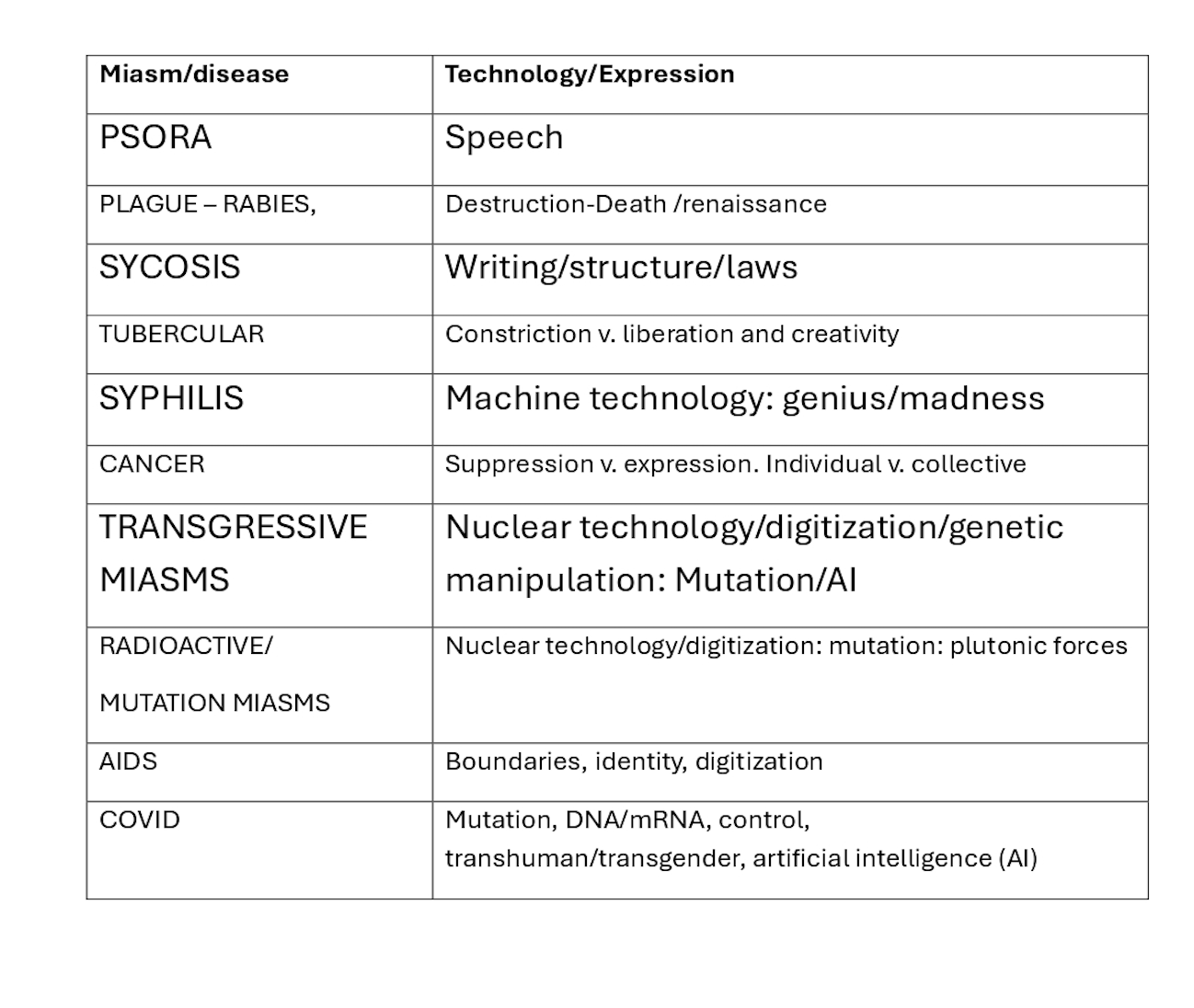
When Fraser wrote the book, The AIDS miasm, we had not experienced the so-called pandemic of Covid-19 which affected the whole world in simply unbelievable ways. We had never seen anything like this in the world before, a collective impact of a “virus”, in which most countries in the world then locked their countries down as a result and introduced the most draconian limitations on freedom of movement and also on medical choices that one can make. A deeper analysis of these events will follow, but at this point, it seems appropriate to accept that Covid-19 and its larger social and political expression deserves to be classified as a miasm.
In this analysis I am going to identify it along with the AIDS miasm as they both have certain parallels of being a physical, apparently infectious condition, with significant impact to those affected and in which there is a possibility of them both being man made conditions. One of the unique aspects of AIDS though is that it isn’t a specific disease, but a syndrome, its impact leading to a potentially wide range of conditions, but it's similar in that the expression of Covid could also be fairly broad. Covid could be called the “revealing” miasm in that how individuals and even countries responded to it reflected some intrinsic qualities of their nature, physiology, and the broader social/cultural dynamics.
In this context I am putting them into the category of being a Transgressive miasm, in that they originate from the machinations of human intervention and similar to the development of nuclear energy and weapons introduces a red line which has been transgressed. That red line in the Radioactive Miasm is now the ability to blow up the world, to destroy the planet and all of humanity. We have now lived with this reality since 1945, and to this day we all live with the existential threat of a nuclear holocaust. This threat may come and go, as we see in relations with Russia right now, and also with the situation in the Middle East and Israel having a nuclear weapon. But it also ties into evolving science of genetic technology, and humans transgressing certain boundaries, in that we can adapt human genetic actions, we can manipulate the body at will, and we can change sexes, to some extent. It can be called transgressive in that we have crossed a certain rubicon by manipulating the foundation of life, our DNA. Now with Covid, we have introduced a vaccine based on mRNA technology that seems to be able to affect the genetic DNA, even if scientists deny this. With Covid, we saw the biggest medical and political manipulation ever onto the human condition with experimental technology that threatens to change human DNA.
As the scientist Robert Oppenheimer quoted from Hindu text, the Bhagavad Gita, when he witnessed the Trinity Test, the first detonation of a nuclear bomb, “Now I have become Death, the destroyer of worlds.” In other words, we have truly opened up the Pandora’s Box of profound responsibility and potential conflict for human behaviour. To hold in one’s hand the future of humanity and the planet, to know that with one button one could unleash hell on earth, a transformative and transgressive act which can never be undone. If one can imagine the pressure, the weight, the awesome sense of both omnipotence and yet utter destruction. This in itself sets up an influence or miasm of energetic force, of consciousness that has never been experienced before. Oppenheimer said he quoted this because of the feelings of responsibility, duty and awe-inspiring destruction of the atomic bomb.
In recent years in homeopathy, we have explored newer remedies, ones not used before, which come from the areas of the chemical periodic table which connect to radioactive elements and the human use of these, including Radium, Uranium and Plutonium. These are in the Actinide series of elements and there are also the Lanthanides, both series connecting to issues to do with life and death, conscious and unconscious forces, relating to the planet/star Pluto and the underworld. (12) We could say we have unleashed the underworld, we have brought the world of light and dark together in a potentially devastating destructive act. Or it may lead to the integration of the dark and the light and allow a greater realization of human potential for all.
It can be described in situations where it is all or nothing, a sense of extreme polarity in life, a sense of possible or imminent death. It may feel like the issues being faced are no longer personal or recent but have their origins in ancestral or historical time, an unleashing of hidden or suppressed forces that are forcing themselves to the surface of consciousness. Interestingly, two connected remedies, Radium bromatum and X-ray are indicated when there is a history of deep suppression of physical conditions, leading to a breakdown of the body, including cancer, or for any long-term suppression.
Correspondingly, it is seen in the remedy X-ray a violent expression with a desire to kill with great rage. There is a misanthropy and hatred, and for wounds that refuse to heal (like radiation burns). This is a metaphor for mental states where nothing is ever forgiven or forgotten, like historical wounds in the psyche of a country. With Plutonium nitricum, we see a person living under a huge pressure, immense responsibility and a deep conflict with forces outside their control, a balance between control and chaos. There is a feeling of the body breaking apart, as if made of glass. There may be great suppression of all emotions, of anger, a need to control everything all the time. But there may be compensatory aggression and recklessness, a sense of disintegration, as if things will explode. There may even be a feeling of being divided in one’s identity, of feeling half-animal, half-human. Physically, like with the syphilitic miasm, of which it is an extension, there is an affinity for bones, joints, auto immune conditions, and destructive physical processes.
Mutation Miasms: Contagion
One theme of the radioactive and AIDS and Covid miasm is that of mutation. The following themes can be identified as characteristic of this miasm but also connected to the main miasms of Psora, Sycosis and Syphilis. Leprosy can be said to extend from Psora and TB, as the Plague can do, whereas AIDS came out of Sycosis and Syphilis in the West and Psora and TB in Africa.
Man made manipulation
Mutation
DNA/genetics
Destruction
Isolation/outcast/rejected/sin
Loss of protection (AIDS)
Contamination/contagion (common theme in all nosodes) dirt, guilt, shame
Self-loathing
The aspect of contamination/contagion is consistent with all the miasms, each in its own way. The following is a description of each:
Psorinum: dirt, fleas, hygiene, itching
Medorrhinum: discharges, sex, excess, lack of morality
Syphilinum: dirt, guilt, shame, hiding, chameleon, self-loathing, despair, anguish
Leprominum: disgust, disfigured, stigma, isolation, hopeful, white coloured clothes
Plague (Yersinia): fleas, dirt, fear, rats, isolation, escape, travel.
Smallpox (Variolinum): smallpox, disfigured, squalor, dirt, skin, growths, vaccination, compulsion, resistance.
AIDS: sin, shame, guilt, excess, suppression, denial, identity, stigma, isolation, hatred, contamination, vaccines.
Covid: mutation, DNA/RNA, man-made, hiding, lying, manipulation, disinformation, isolation, locked down, control, suffocation, surveillance, digital control, matrix, fear, isolation.
Conclusion
The dynamic interface between technology, disease miasm and human consciousness needs to be seen within a holistic framework of expression, evolution and change. As we become aware of a greater wholeness and interconnectedness, we need to balance the temptations of using technology for greater control in an ever more complex world and the need for necessary human connection to each other and to the world at large.
But we can also use “technology” in the broadest sense as a metaphor in order to further understand what it represents for us all and its relation to broader society. Within homeopathic terms, it can also be a useful tool to look at the patterns of phenomenon that we observe and experience in our lives and the potential impact it has on our health. The miasmatic theory and practice as first expounded by Hahnemann can be expanded now to identify patterns of thought and energy and how it is connected to broader technological and socio/cultural patterns. In that context certain significant disease conditions, including AIDS and Covid, can be understood as a symptomatic expression of a larger “gestalt” in society at large.
As we navigate beyond the limited imagination of a mechanistic, reductionistic world, we can hope that this will bring greater health, awareness and freedoms. However, by looking at these patterns homeopathically and introducing the concept of miasms to this exploration, we can also make connections and perceive patterns to disease expressions within a larger context.
References
https://web.archive.org/web/20120410100833/http://immunity.org.uk/media/Continuum%20PDFs/v3n5.pdf
Testing, Testing… Do HIV Antibody Tests Prove HIV infection.
Valendar Turner MD, Department of Emergency Medicine, Royal Perth Hospital, Perth, Western Australia. First published in Continuum Magazine Vol 3, No 5. Revised in July 2001.
A Study from Zaire (DRC), in which 67% of leprosy patients and 23% of their contacts tested HIV positive, found that only two of the patients and none of their contacts could be confirmed as positive using more detailed and expensive procedures. Even the two cases were questionable. (Molecular Miscarriage: Is the HIV Theory a Tragic Mistake
Neville Hodgkinson. Mothering magazine, Sept/Oct 2001)
See the movie The House of Numbers. Although criticized by conventional AIDS researchers and ‘Experts’(see Wikipedia site), it provides an interesting critique on the accuracy and validity of AIDS tests
According to Project HEAL in Los Angeles, the following conditions can lead to false positive results - “naturally occurring antibodies, exposure to viral vaccine, flu, flu vaccination. TB. Renal failure, hepatitis, organ transplant, hemophilia, tetanus vaccine, leprosy, alcoholic liver disease, blood transfusion, malignant cancers, rheumatoid arthritis, herpes, Hepatitis B vaccine, etc.
A number of rapid tests were taken off the market in New York in 2008 because of a high number of false positives, according to U.S News on June 23, 2008.
“Now that an estimated 1 in 4 Americans with HIV is infected without knowing it, tests that provide rapid results have been welcomed with open arms. But imagine if you were told you're HIV positive and later learn that you actually don't have the virus. In New York City, some people have had that experience: One rapid test that examines oral fluid samples—the OraQuick Advance Rapid HIV-1/2 Antibody Test—has produced a higher than expected number of false positives, leading the city's Department of Health and Mental Hygiene to suspend use of the test in its STD clinics; the OraQuick finger prick test is still in use.
“Jennifer Ruth, a spokesperson at the Centers for Disease Control and Prevention, says the agency is investigating clusters of false positives associated with the oral test in other jurisdictions as well. The uptick in false positives was the subject of the CDC's June 18 Morbidity and Mortality Weekly Report. (OraSure Technologies, the maker of the oral test, says that while New York City data showed higher than expected rates of false positives, the nationwide data the company has gathered are reassuring.) The CDC has not yet determined the cause of the increase in false positive results but is planning a study in areas that perform large numbers of HIV tests and have experienced an increase in false positive results.”
Deborah Hayden. (2003) Pox: Genius, Madness, and the Mysteries of Syphilis. New York: Perseus.
https://rsarchive.org/Medicine/GA027/English/RSP1983/GA027_c13.html
HIV-associated tuberculosis (TB) remains a substantial challenge to international public health, accounting for an estimated 1.1 million new TB cases and 0.35 million deaths worldwide in 2010. A staggering 82% of these cases and 71% of deaths were in sub-Saharan Africa. This burden of disease represents a particular challenge to antiretroviral treatment (ART) programmes in the region as it is concentrated in patients accessing these services [2,3]. Approximately 5–40% of patients enrolling in ART services have a current TB diagnosis at the time of starting ART [2–8]. In addition, there is a high incidence of disease during the initial months of ART, much of which represents prevalent disease present at baseline that was not detected during screening. Long term rates are lowered substantially during ART, but nevertheless remain several fold higher than rates in HIV-uninfected people living in the same communities.
World Health Organisation Global tuberculosis control 2011. Geneva: World Health Organisation. WHO/HTM/TB/2011.16.
According to the Karonga Prevention Study (in process of changing its name to the Malawi Epidemiology and Intervention Research Unit), a large research program in Northern Malawi that focuses on the link between tuberculosis and AIDS (sponsored by the Wellcome Trust), up to 60% of T.B. cases are HIV positive.
Government-by-exception: Enrollment and experimentality in mass HIV treatment programmes in Africa Author: Nguyen, V K. Publication info: Social Theory & Health, suppl. Special Issue: HIV/AIDS 7. 3 (Aug 2009): 196-217.
Abstract: This paper explores the implications of mass HIV treatment programmes in Africa, particularly when non-governmental organizations, American universities or European hospitals, directly govern the lives of populations (such as those living with HIV) and in fact have power of life or death over them. It explores a novel form of legitimate, therapeutic domination that results from framing the epidemic as a humanitarian emergency. That lives be saved requires enrolment: that a standardized population be called into being so that it may then be targeted, relying on the deployment of biological and political technologies for constituting populations and transforming bodies and subjectivities. These transformations that seek to direct consciousness and change bodily practice are governmentalities exceptionally directed at the biological existence of those living with or potentially at risk for HIV. And, in an inversion of the classical model whereby evidence of efficacy permits intervention, in this case intervention drives the need for self-validating evidence (that is, the intervention was effective). The conjugation of these standardized humanitarian problems and populations with the production of post-facto, self-validating knowledge (most often described as 'lessons learned' or 'best practices') is an 'experimentality' that leverages the deployment of these interventions across the globe.
Molecular Miscarriage: Is the HIV Theory a Tragic Mistake, Neville Hodgkinson. Mothering magazine, Sept/Oct 2001
Out of Control: AIDS and the Corruption of Medical Science. Celia Farber. March 2006. Harpers Magazine
“At the time of the Nevirapine trial, President Bush was announcing his latest PEPVAR policy and they needed a new drug. The FDA’s report on the shambles of the trial in Uganda was quashed and any potential whistleblowers silenced. Nevirapine, like other ARV’s and protease inhibitors was fast tracked through FDA guidelines and the drug introduced into the market place. Since then it has become one of the main 1st line drugs to treat AIDS. “
“The failure of the HIVNET researchers to properly control their study with a placebo group is not as unusual as one might think. In fact, this failure is perhaps the outstanding characteristic of AIDS research in general. The 1986 Phase II trial that preceded the FDA's unprecedented rapid approval of AZT was presented as a double-blind, placebo-controlled study, though it was anything but that. As became clear afterward through the efforts of a few journalists, as well as the testimony of participants, the trial was “unblinded” almost immediately because of the severe toxicity of the drug. Members of the control group began to acquire AZT independently or from other study participants, and eventually the study was aborted and everyone was put on the drug. As in the case of HIVNET, documents obtained by journalist John Lauritsen under the Freedom of Information Act subsequently suggested that data-tampering was widespread. Documents were altered, causes of death were unverified, and the researchers tended to assume what they wished to prove, i.e., that placebo-group diseases were AIDS-related but that those in the AZT group were not. So serious were the deviations from experimental protocol at one Boston hospital that an FDA inspector attempted to exclude data from that center. In the end, however, all the data were included in the results, and the FDA approved the drug in 1987.”
Sherr, J. (1999). The Proving of Plutonium, Its Methodology, and the Collective Toxicology of Ionizing Radiation. Dynamis School of Homeopathy