
The Scholar and the Scoffer: A Conversation with Frans Vermeulen
Interview conducted by Kirsten McGregor
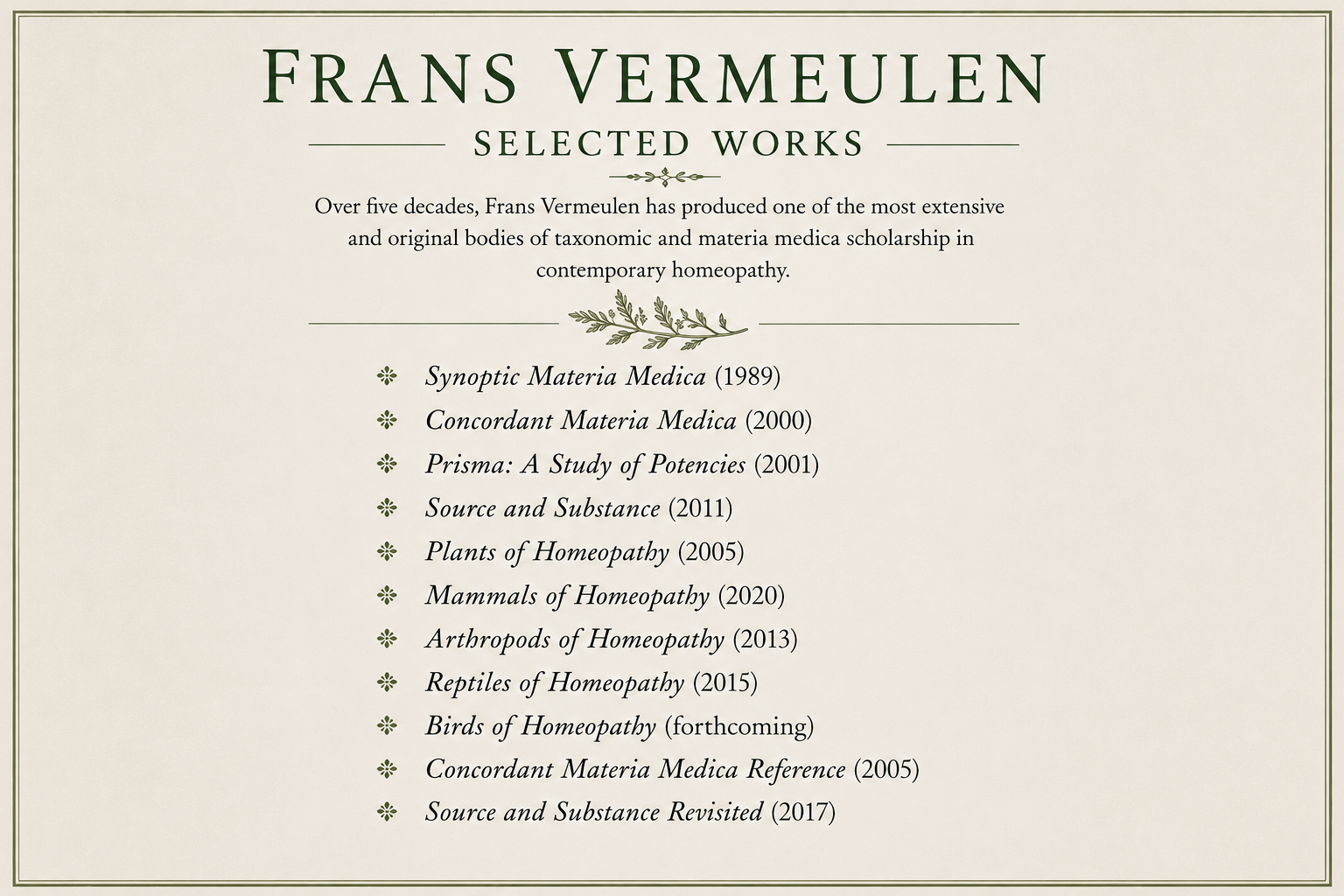
Frans Vermeulen is one of the most consequential figures in homeopathic scholarship of the past half-century. His Synoptic Materia Medica and Concordant Materia Medica have shaped how generations of practitioners study and apply homeopathic remedies. His ongoing animal series — covering reptiles, arthropods, mammals, and now birds — represents a systematic integration of natural history, taxonomy, and homeopathic materia medica unmatched in the field. He has spent fifty years as a solo investigator, translator, and taxonomic critic, working largely outside institutional homeopathy. He is, in his own words, a scholar and a scoffer.
This conversation ranges across the foundations of materia medica, the philosophical incompatibility of Darwinian evolutionism with homeopathic first principles, the nature of the vital force, the misuse of provings, and the uncertain future of homeopathy in a materialist culture.
I. Origins: There Is More Than Matter
Kirsten: Your work has shaped how several generations of homeopaths study and apply materia medica — from Synoptic to Concordant, and now through your animal series. But what I find equally striking is that your scholarship has always been in service of a larger claim: that homeopathy belongs to a different understanding of what nature is, what a living organism is, and ultimately what the human being is. I want to begin not with the books, but with you — with how you arrived at that view of the world.
Frans: I have thought a great deal about how these things came about, because I was more or less destined to become a schoolteacher — a choice my father made for me. I was good with children. I probably would have been fine. But there was always something else.
The best way I can explain it is to tell what happened when I was seven years old. We lived in a tiny village in the northwest of Holland, just below sea level. One clear night, my father took my hand and we walked to a museum — about how humans had descended from simians, with that classic picture at the entrance of an ape straightening up step by step into a human. I can still see it.
When we walked back, I looked at the sky, and as a child of seven, I was completely overwhelmed by something. Don't ask me what it was. There were no words to it. It was a sensation. And I think that sensation has always been with me: there is more than matter.
That developed over time. Around twenty I began reading in the Rosicrucian and Theosophical traditions, esoteric and hermetic literature. That led me to believe the human organism was more than a physical body — which led me toward homeopathy. Not mainstream. And early on, I understood that reality could not be reduced to matter alone.
Kirsten: What strikes me about that story is that the museum was about evolution — about the materialist account of human origins — and you walked out of it looking at the stars and feeling the opposite. That tension has never left you.
Frans: I am still following it, seventy years later. There is a streak of anti-authority in me — I will not deny it. Someone once called me a scholar and a scoffer. I am a scoffer in the sense that I scoff at established things that are supposedly true because there is consensus about them. Hahnemann was the same. He was a scholar and a scoffer, highly interested in the immaterial.
II. Materia Medica and Taxonomy: What Is Behind the Name?
Kirsten: You started as a student of the materia medica, not as a philosopher of homeopathy. But your taxonomic work has become increasingly philosophical — the argument that knowing a substance's correct scientific name and family relationships is not merely academic housekeeping but clinical intelligence. Where did that conviction come from?
Frans: In the beginning, what we received at the classical homeopathy school in Holland was copies from Clarke, Hering, or Allen. And what interested me from the start was the materia medica, not the philosophy. It connected me to the natural world. I like categories. I like lists.
I still remember coming back on the train and looking at people, thinking: those upper eyelids are heavy, that must be Gelsemium. That is what I knew — Aconite, Belladonna, Gelsemium. Everyone was one of those three.
But at a certain point I started looking behind the words, behind the names. And I started noticing that the naming was not always consistent — not in line with current botanical or zoological nomenclature. I thought: if homeopathy wants any place at the table, it needs to use correct names, correct scientific classification. That was the first inconsistency that struck me, and it runs deep.
Kirsten: So we are prescribing names as if they were substances — and the names themselves are often wrong, or at best uninformative. Can you give us a sense of how pervasive the errors are?
Frans: The names in our materia medica are often not linked to the substance from which the remedy derives. For example with Rhus toxicodendron and Rhus radicans there has been confusion. Symptoms attributed to one get copied into the other, then repeated again in repertories and later materia medica. Once something enters the literature, people continue copying it. That is one of the real problems.
Students often simply prescribe a name they found in a repertory. They do not know what that name refers to. They might as well have been given a number.
How many students know that Dulcamara is in the same genus as the potato? As the tomato? If you know that Dulcamara is Solanum dulcamara, you already know it belongs to the Solanaceae — the same family as Datura, Belladonna, Capsicum. That is clinically meaningful. The grouping carries information. But if the name is just a word, it carries nothing.
Kirsten: And this is not a problem confined to historical remedies. It runs directly into what pharmacies are manufacturing today.
Frans: The errors become catastrophic. Spiders are a disaster. Tarentula cubensis does not exist. Mygale lasiodora does not exist. Tarantula hispanica is wrong. The wall spider from Kentucky has no valid scientific name. I went back to Walckenaer's original arachnological catalogue — the authority cited for Mygale lasiodora — and the name does not appear there. The Cuban physician who introduced it attributed it to the wrong source entirely. And pharmacies today are still manufacturing remedies from names that correspond to nothing.
The smaller the animal, the more mistakes. Insects: poor. Spiders: disaster. And nobody takes it seriously — that is what troubles me most.
III. Two Sources, One Confusion: Hering and Allen
Kirsten: The materia medica presents itself as a unified body of knowledge — but you are saying it was never unified. It has two epistemologically distinct roots that have been quietly conflated. Can you explain that distinction, and what it means for how we should read our sources?
Frans: This took me time to understand. In the beginning, I used Hering as the basis of the Concordant — in good faith. Later I realized that most of the additional authors I incorporated were simply republishing Hering. No new primary data. Just another iteration of the same clinical observations.
The essential distinction is this: Hering is clinical — observations of patients. Allen is proving, toxicology, self-experimentation. Fundamentally different categories, mixed together without acknowledgment. When you read Allen in the original, he gives the authority for each symptom: the journal number, the German reference, the prover. That is a provenance trail. Later, particularly digital editions stripped it out.
The same problem appears in the repertory. Clarke's “complements” and “follows-well” designations are single clinical observations — random, without pattern. There is no botanical or zoological logic behind them. Real complementarity lies in taxonomy: the genus or family in plants, the family or grouping in animals, the position in the periodic table. Not in Clarke's notebook.
Kirsten: So the materia medica has not only failed to grow — it has been actively diluted by the incorporation of material that does not belong there on its own terms.
Frans: It is extraordinary. In my Source and Substance project I catalogued 4,231 remedies from the existing literature. Less than twenty percent have any genuine proving basis. The rest comes from herbalism, aromatherapy, dietary recommendations, pharmaceutical side effects. These describe what a substance is said to cure, not what it produces. That is the opposite of the homeopathic method. And it sits in the repertory, undifferentiated, alongside Lachesis and Sulphur.
IV. The Polychrest Problem and the MilleFolia Project
Kirsten: One of the structural paradoxes of homeopathic practice is that the remedies that receive the most attention, attract more attention still, while the vast majority of the pharmacopoeia remains practically invisible. The polychrest becomes a self-fulfilling prophecy. Is there any way out of that loop?
Frans: It is built into the repertory itself. Repertory makers expand by adding symptoms — and they add them preferentially to remedies that already have many. Lachesis now has upwards of twenty thousand symptoms. A closely related snake remedy, Crotalus cascavella, has five thousand. There is no clinical justification for that ratio. It reflects editorial momentum, not reality.
The polychrest status of sulfur, calcium, magnesium — that is earned; those substances genuinely pervade the human organism. But the rest of the inflation is distortion. It makes unbiased selection almost impossible.
The solution I am working toward is a project called MilleFolia — roughly 1,300 remedies, each given an equivalent, capped range of symptoms. No remedy gets three pages while another gets three lines. Everything is organized by natural categories — botanical families, the periodic table, zoological groupings — so that a prescriber who finds Calcium carbonicum is immediately prompted to consider other calcium salts, magnesium salts or barium and strontium. The taxonomy does the work that arbitrary listings cannot.
Kirsten: What you are describing is essentially a parallel materia medica — organized by natural relationships rather than historical accident. How does it sit alongside an existing repertory infrastructure that is deeply entrenched?
Frans: With great difficulty, because repertories profit from expansion, not from correction. That is an honest answer.
V. Provings: A Mistranslation and Its Consequences
Kirsten: Provings are the epistemological cornerstone of homeopathy — the foundation on which clinical authority rests. And yet you have been pointed in your critique, not just of individual provings, but of the concept itself. What is actually wrong with provings as a basis for knowledge?
Frans: Proving is a mistranslation. The German is Prüfung — a test, a tasting. In Dutch, proeven means to taste: the spoonful you take of your soup. The English word proving implies evidentiary weight — it suggests something has been proved. From that implication we have constructed an apparatus of methodological rigidity that has no historical basis.
There is no such thing as a classical proving. Hahnemann proved on a handful of people — colleagues, his wife, his daughters. The methods varied entirely: number of provers, potency used, duration, interpretation. No protocol runs from Hahnemann to the present.
And provings are inherently bounded by the human beings conducting them. Hahnemann could only produce what was in Hahnemann. Language changes, and more insidiously: the vocabulary of one proving infects the next. The moment Jeremy Sherr — whose work I otherwise respect greatly — introduced the word ‘aloof’ in one of his provings, that word began appearing across subsequent provings from other practitioners. Kent originally had only Lycopodium under the rubric ‘Love of power’. Then the floodgates opened. That is not fresh data. That is zeitgeist.
Kirsten: Which raises a question of accountability. If anyone can prove anything — cling wrap, dog excrement, a brick from the Berlin Wall — and the results enter the literature without oversight, how does the field distinguish signal from noise?
Frans: None. Someone can prove cling wrap. They have. Dog excrement. They have. We have over two hundred Asteraceae in the repertory. Meanwhile, bryophytes — the mosses — have almost no homeopathic attention. We need some regulatory body that says: here is what is actually missing. Not another daisy.
VI. Vitalism and the Post-Mechanistic Turn
Kirsten: The vital force is the concept that sets homeopathy most sharply apart from biomedicine — and also the one that draws the most skepticism. How do you hold it? Not as a historical artifact of Hahnemann's era, but as something with explanatory force today. And is it, even in principle, something science could eventually approach?
Frans: I would call it an organizing principle. Like a conductor dressed in black — present, directing, but not meant to be seen. Or a referee: necessary, but not the point.
I use the Rosicrucian model, which is essentially the same as the Anthroposophic: mental body, astral body, etheric body, physical body — each arising not causally from the others, but all arising from a single underlying force that we cannot see. That is the Dynamis. It does not travel from mental to physical in sequence. It affects all bodies simultaneously, differently depending on where an individual is most sensitive.
Hahnemann wrote: “In our time, which boasts such enlightened and deep thinking souls — is it truly impossible to conceive of a non-material dynamic force we see around us every day, in so many phenomena that cannot be explained in any other way?” That is still the right question. And there is no way we will ever find out what the Dynamis is. It is, by definition, beyond our measuring capacity.
Consider a single cell — something this small — containing information equivalent to perhaps a hundred thousand full libraries. How can matter hold that? DNA is the tool, the ink of the writing, so to speak, but not the writer itself. Like with the ears or eyes; you don’t hear with the ears, you hear through the ears; idem with the eyes, the other senses, and DNA. It is not the thing itself.
Kirsten: What you are describing maps closely onto what Ayurveda calls the pancha kosha model — five sheaths nested around an innermost self, all arising from a single source that cannot itself be objectified. Two systems geographically and historically remote, arriving at the same architecture.
Frans: Yes. The direction matters enormously: inside-out, not outside-in. What appears at the periphery comes from the center. That is the homeopathic premise. Not that external forces have shaped the organism — but that the organism expresses what it already is.
VII. Against Evolutionism: A Philosophical Incompatibility
Kirsten: Several of the most influential developments in modern homeopathy — Sankaran's sensation method, Scholten's periodic table work, various plant kingdom hierarchies — are organized around precisely the evolutionary and developmental frameworks you reject. You are not making a minor methodological objection. You are saying these frameworks are philosophically incompatible with homeopathy's own foundations.
Frans: Darwin proposed that life developed from itself through random forces — natural selection, mutation, external pressure. That is an outside-in philosophy. It claims that capacities are not innate but are produced by circumstances. That is the complete opposite of what homeopathy presupposes: that every organism is innate in itself, has capacities that are inborn, and expresses them from the beginning.
Evolution also claims there is nothing beyond matter. If we adopt that language in homeopathy — developmental hierarchies, organisms shaped by external pressure — we are agreeing with a tendency antithetical to the core idea.
Kirsten: And yet those systems have produced clinical results that practitioners find compelling. If the philosophical foundation is wrong, how do you account for the fact that they sometimes seem to work?
Frans: And I think it is to homeopathy's detriment. You cannot make a developmental hierarchy of the plant kingdom on the basis that Asteraceae are primitive. They are not. If the evolutionary overlay of the periodic table onto the plant kingdom were actually true, two practitioners using the same system would produce the same results. They don't. Because the overlay is constructed, not discovered.
I prefer to quote naturalists from the nineteenth century, before Darwin's influence became total. They describe animals without the lens of survival of the fittest. They describe animals living. That is a crucial distinction. No animal is busy surviving. An animal is busy living. The moment you frame everything as survival, you have already distorted what you are seeing.
Kirsten: I want to stay with that, because it seems to me that your critique of evolutionary frameworks is inseparable from your understanding of what simile actually means. They are two sides of the same argument. Can you lay out what you mean by similarity as the core operating principle — and why getting it right matters so much?
Frans: I have strong opinions about that. It took me fifty years to arrive at them.
VIII. Simile as Principle: Resemblance, Not Identity
Kirsten: How do you define what homeopathy fundamentally is?
Frans: The essence is similarity. It is in the word itself. The synonyms for simile are analogy, metaphor, comparison, resemblance, similitude, parallel. A figure of speech that expresses resemblance between things of different kinds — formed with “like” or “as if”.
Imagine a circle. Things arise from the inside out and appear at the periphery. If we find a substance whose effects resemble what is appearing in a patient, then the source of those effects at the center must be the same. There is no other logical possibility. What is similar on the outside must be similar at the center.
That is why anthropomorphism is acceptable in homeopathy, and why it is not acceptable in evolutionary biology. In homeopathy, observing that a person behaves like a bird is a simile — a resemblance. We are not claiming they are a bird, or were one. We are observing resemblance. The resemblance is real; the source of the resemblance must also be real. That is the foundation.
IX. Jung, Whitmont, and the Intrinsic Nature of Substance
Kirsten: I have been reading Whitmont's Psyche and Substance — a book you know well, as you translated it into Dutch. Whitmont suggests that substances carry a numinous charge, an invisible significance, and that this charge can be intensified through engagement, through attention, even through something like ritual relationship. Jung called it participation mystique. I wonder whether the years you have spent inside these substances — their biology, their folklore, their classical literature — might itself be a form of participation that reveals what would otherwise remain latent. Is remedy action purely intrinsic? Or does the quality of attention brought to a substance matter?
Frans: I think it is purely intrinsic. But I am genuinely glad you raised Whitmont — I translated Psyche and Substance into Dutch before I began writing materia medica. I loved it. Whitmont was a Jungian, and what I take from the Jungian tradition is the concept of the archetype: something that exists beyond the individual. I believe in that.
But whether the soul affects the body, or the body the soul — my answer is no. Both are affected by the same underlying force, the Dynamis, but not by each other. What the body expresses in its language corresponds to what the soul expresses in its language. They are parallel expressions of the same source. Counseling may have temporary effects. It does not reach the Dynamis.
Kirsten: Let me press that a little. I am not asking whether we change the substance. I am asking whether rigorous, sustained, even loving observation — the kind that characterizes your work with birds — might reveal aspects of a substance's nature that a more mechanical approach would miss. Not co-creation, but a deeper recognition. Does the quality of the observer's attention matter?
Frans: I find I have to think about that. But I suspect my answer is: the intrinsic nature of a substance is fixed. It was placed there. We observe it. We do not co-create it. We may become better at seeing it — but what we see was already there.
Kirsten: So the observer does not alter what is observed — but may become more capable of seeing it. Which suggests that knowing a bird remedy through its biology, its poetry, and its environment is not incidental enrichment but part of what makes accurate prescribing possible.
Frans: Yes. And similarity is not identity. We are not animals. We may behave like one — but it is resemblance, not sameness. The distinction is not semantic. It is the entire philosophical foundation.
X. Structure, Pluralism, and What Must Not Be Lost
Kirsten: Hahnemann revised the Organon six times. He possessed a deep resistance to received authority, including the authority of his own prior conclusions. And yet over time, the field has generated enormous diversity in method — sensation prescribing, combination remedies, potency chords, intuitive approaches. Some see this pluralism as vitality. Others see it as fragmentation. Where do you draw the line between productive evolution and the loss of something essential to the integrity of homeopathy?
Frans: I want to push back on the premise. What is actually rigid? The materia medica did not arise from a single coherent method. It emerged from Hahnemann's self-experiments with crude substances, from Hering's clinical observations, from Kent's philosophical interpretations, from Swan's potentizing machine in Brooklyn, from Compton Burnett's herbal extensions. That entire mix-match became what we call the materia medica. There was never a protocol. Hahnemann did not use the 30C. He revised the Organon six times. In the first 5 editions, according to which he did his provings, there is no mention of 30c. The 30C was Kent's introductionas the standard potency for provings.
The real danger is not rigidity but the opposite: the loss of any standard at all. Combination remedies cannot guarantee that their constituents are not antagonizing each other. How can you be sure they are all singing from the same hymn sheet?
Potency itself is not standardized. Skinner, Swan, and Fincke all used different machines and different counting methods. Swan's high-potency CMM designations are actually -- after careful analysis -- no higher than a C6. The entire edifice of potency as a systematic dimension rests on a historical accident.
Kirsten: And yet the field functions. Clinicians arrive at the correct remedy through very different routes — including routes you find theoretically untenable. What does that tell us?
Frans: Yes. And I am not a prescriber — my wife Linda is the prescriber in this house, and she is excellent. I cannot claim my theoretical position is better than Sankaran's or Sherr's or Kent's. What I can say is that the totality of unique and characteristic symptoms — covering mind, generals, and the most affected organ, four or five symptoms that cannot be accounted for otherwise — gives the safest ground. But the charm of homeopathy, and its frustration, is that it can be arrived at from many directions.
The point at which I draw the line: the primary principle is similarity. Potency is secondary. Provings are a test, not proof. And anything that replaces resemblance with something else — developmental hierarchy, evolutionary overlay, the shortcut of combination — has left the field, whatever name it operates under.
XI. The Birds, and the Animal Within
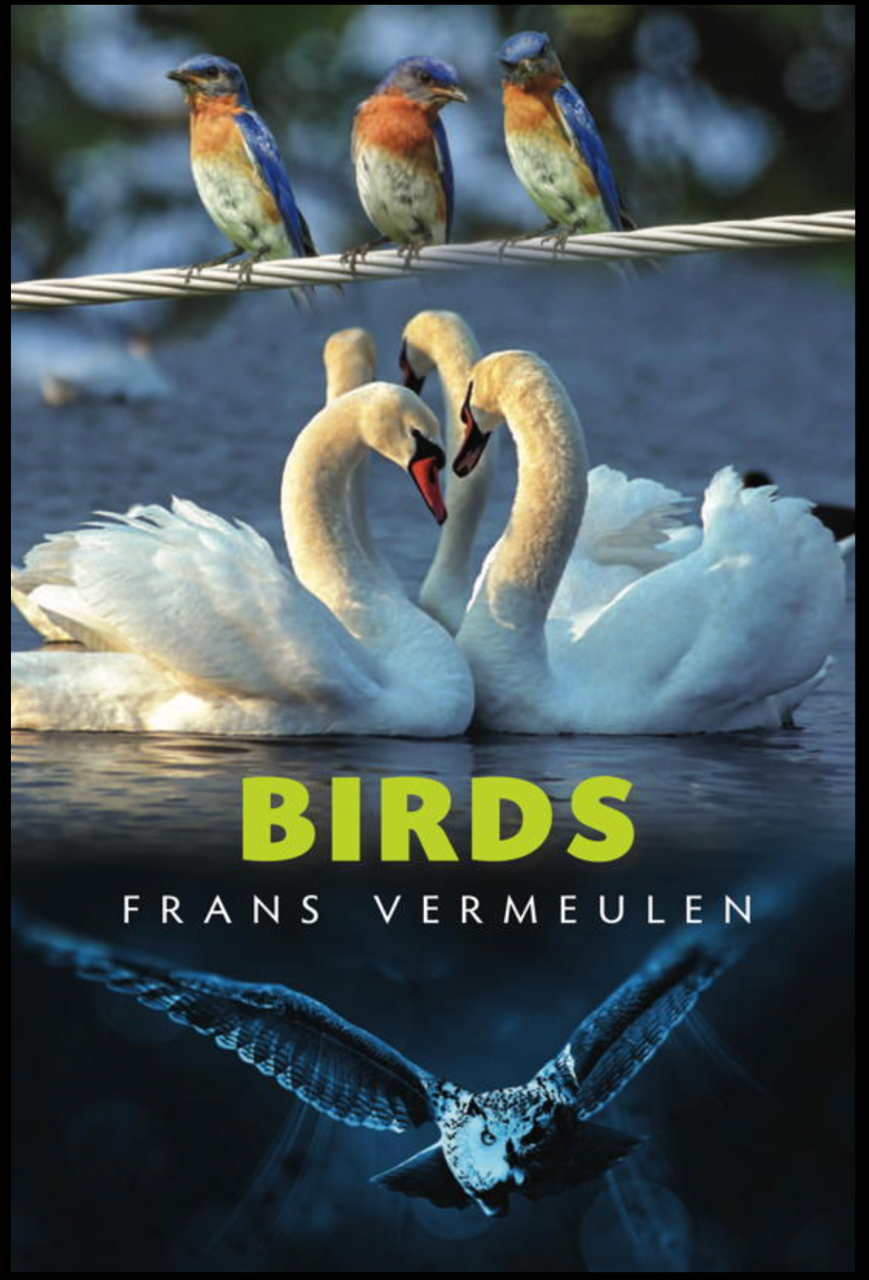
Kirsten: The birds book is the culmination of your animal series — a project that has occupied decades of your life. But I sense that the birds hold a particular place. You have spoken about the skylark overhead in Holland, the hummingbirds in California feeding from your hand. There is something in this book that goes beyond scholarship. What is it that birds carry for you?
Frans: When it comes to personal affection, birds have always been first. I still carry the memory of sitting in the garden as a child in Holland — the skylark singing overhead. I had no idea what it meant. I still remember it.
Later, when we lived in California, I had eight hummingbird feeders at a time. On the best days, eighty hummingbirds of three or four species. If I stood still outside, they would feed from my hand.
The birds book is the final volume in my animal series — after reptiles, arthropods, and mammals. There are over two hundred bird remedies in pharmacies. Perhaps sixty or seventy have received serious homeopathic attention. What I am doing is collecting the full biological material first: environment, behavior, ecology, poetry, folklore — then reading the existing homeopathic literature and connecting it to that biological foundation.
The principle comes from Emerson: “I thought the sparrow's note from heaven, singing at dawn on the alder bough; I brought him home, in his nest, at even; he sings the song, but it cheers not now, for I did not bring home the river and sky.”
You cannot bring home the sparrow without bringing home the river and sky. You cannot describe a caged nightingale and claim you have described the nightingale. An organism cannot be understood apart from its environment. That is the biological principle and the homeopathic one.
Kirsten: You cited Chapman — and the phrase that stops me is the bird within us. That phrase does a great deal of philosophical work. It implies that there is something in us that corresponds to the bird — not because we evolved from it, not because we share ancestry, but because the same source has left a resemblance in both. Is that a fair reading?
Frans: Frank Chapman, an ornithologist of the early twentieth century, wrote a gloss on that Emerson poem that I think explains homeopathy better than most homeopathic writing: Proving that it is primarily the freedom of bird life that appeals to us — and to which, in endless ways, the bird within us responds.
The bird within us is not a bird. It is the resemblance to a bird. Something innate in us corresponds to something innate in the bird — placed there, I believe, by the same designer. That is the simile. That is why it works.
XII. The Future: Honest Assessment
Kirsten: You have worked in this field for fifty years, largely as an independent scholar, outside the institutional mainstream. You have watched the field grow, proliferate, and in some respects fragment. You have watched the political and scientific climate become increasingly hostile. What is your honest assessment of where homeopathy stands — and what, if anything, gives you confidence about its future?
Frans: I am honest about this. The headwinds from allopathic medicine and from the dominant materialist culture are very strong. Conferences are disappearing or moving online. Schools in Europe are struggling — enrollment is down, standards have relaxed. What remains is a practical medical modality that works for certain people in certain conditions. Whether it develops into something categorically new — I do not see that happening.
India is different. There, homeopathy is covered, practiced, and culturally supported by a non-materialist worldview. When the underlying culture does not reduce the human being to matter, these systems have room to exist. In the West, where the materialist premise dominates, we are pushed to the edges.
The comparison I keep returning to: if you question evolution publicly, you are mocked, called anti-science. If you promote homeopathy, the same thing happens. Both operate outside the materialist consensus. Both require accepting that there is more than matter. And as long as the culture insists that everything came from nothing, by chance, and is going nowhere — how can you combine that with homeopathy? You cannot.
Kirsten: I want to give you the final word — directed at the practitioners who read this journal, who have given their working lives to this system and face real clinical pressure and real cultural resistance. What do you most want them to understand, or to remember?
Frans: I would start with Hahnemann and end with Chapman. Hahnemann asked whether, “in a time that boasts such enlightened souls, it is truly impossible to conceive of a non-material dynamic force — one we see evidence of every day, in phenomena that cannot be explained any other way.” That question has not been answered. It has only been evaded.
And Chapman: Proving that it is primarily the freedom of bird life that appeals to us, and to which, in endless ways, the bird within us responds. That is what homeopathy is. Not metaphor, not poetry — recognition. The innate responding to the innate. Resemblance finding its source.
Kirsten: Where does self end — and where does the bird begin?
Frans: That is the same question as whether the universe has an end. No one knows.
Author Bio:
Kirsten McGregor, CCH, AHC, is a practitioner of classical homeopathy and Ayurveda, founder of Metta Integrative Health, and publisher and co-editor of The California Homeopath. Her work explores vitalism, consciousness, and the philosophical foundations of healing traditions in a post-mechanistic world. She writes on homeopathy, Ayurveda, and the emerging dialogue between traditional systems of medicine and contemporary consciousness studies, while educating clients through an integrative clinical practice.